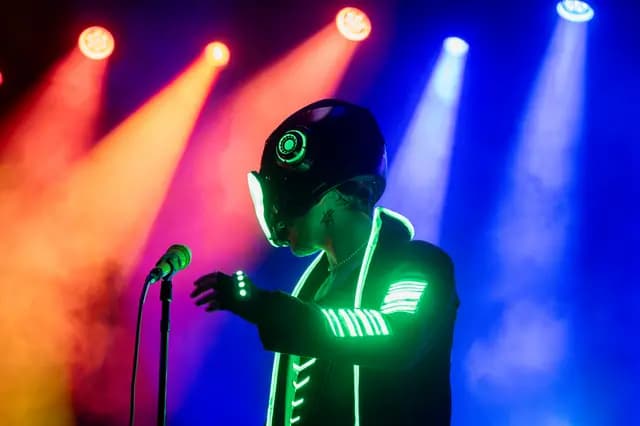
On Saturday, November 8th, RPI’s Game Development Club took over the Union’s McNeil room to host their annual Rensselaer Games Showcase (RGS)–an event where Games and Simulation Arts and Sciences students, members of GDC, and anyone with a project to share are given the spotlight to show off their very own video games. The event allowed visitors to discover and play games made by both RPI students and local studios.
RGS 2025 featured a vast collection of video games. One notable entry was Karkinos’ Ascension by developers Isabela Laboy ‘27, Aiden Crossfield ‘26, Juan Devarie ‘27, Alex Genchev ‘27, Eduardo Huamani ‘27, Eugene Oh ‘27, Kangcheng Yuan ‘27, and Ellie Clifford ‘26. Taking place in the lost city of Atlantis, this game immerses the player into an underwater 3D space as a crab searching for star fragments buried in sand in order to return to its home in the constellation Cancer. The team originally made this game as a submission for their Game Development 1 project, meaning they had only eight weeks to create it from start to finish. However, its polished graphics, fluid movement, and immersive storytelling show no signs of a time constraint for this project. The developers’ hard work even brought them to the San Francisco Game Developers Conference last March–a remarkable feat for these students!
Another entry, A Decade of Eggs from Andi Zhu ‘29, Ella Zhang ‘29, and Char Zheng ‘29, was made during GDC’s September Game Jam–an event where participants are challenged to create a game from scratch in 48 hours. Within this time period, the students developed a puzzle game with charming 2D graphics where you play as a chicken attempting to escape an egg factory. As the chicken, the player is able to lay eggs in order to double jump as well as use these eggs to unlock different areas of each level. Not only that, but if the player dies, they respawn as the last egg they hatched, giving the game room for some creative and challenging level design.
With his personal project Beam Time, Connor Slade 29’ bridges the gap between GSAS and electrical engineering by designing a digital logic simulator with puzzle mechanics involving optics. This game has the player place components such as laser emitters and detectors, mirrors, splitters, and more in order to direct light signals through a map. By implementing these components in increasingly complex fashions, the player develops various logic functions ranging from a simple NOT gate to more elaborate circuits such as decoders, adders, latches, etc. With stunning pixel graphics and a unique puzzle system, Beam Time offers challenging yet engaging gameplay–and not to mention a fantastic study tool for digital logic.
RGS also offered students many networking opportunities by inviting an array of local studios and developers to join the event. Representatives from Tech Valley Game Space, Velan Studios, and more, as well as several industry professionals came to offer insight into the field, portfolio reviews, and even interviews, giving GSAS students a great opportunity to gain footing in the professional world as well as giving studios a strong outreach opportunity. Jeromy Lensky described how Velan Studios is “proud to support and be involved with the capital region, education, and community initiatives.”
The Rensselaer Games Showcase offers a powerful insight into the creativity and talent that is brewing throughout the GSAS department all year round, serving as both an experience for outsiders to learn about game development and, in the words of GDC president Aiden Crossfield, for students “to gain invaluable experience presenting their work.”