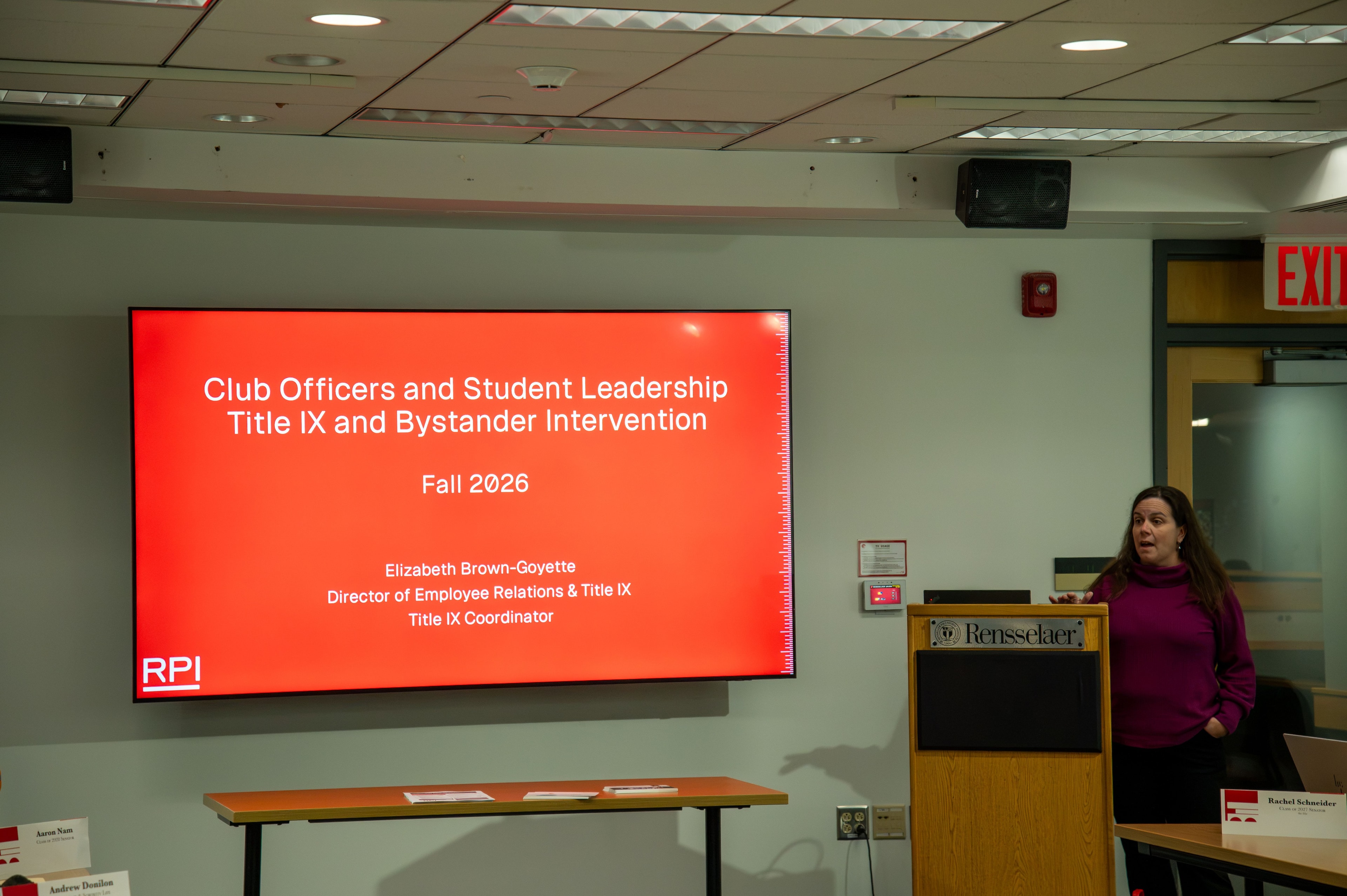

In light of the allegations of sexual assault and drugging at Cornell University, Title IX offices have been under fire for failing to adequately protect students from sexual violence. Title IX is a federal civil rights law as part of the Education Amendments of 1972, which prohibits discrimination on the basis of sex in educational institutions that receive federal funding. The Student Senate organized a question and answer forum with RPI’s Title IX Coordinator Elizabeth Brown-Goyette, Associate Vice Provost for Health and Wellbeing Dr. James Raper, and Dean of Students Dr. Ryan Keytack, via an online survey and senators’ inquiries. Yet, rather than allowing the Student Senate to ask pressing questions, Brown-Goyette first went through the Title IX training session meant for club leadership for close to an hour, despite the fact that all but a few senators in the room had already undergone this training. Academic Affairs Committee Chairperson Zach Nobles ’27 and Residential Life and Dining Committee Chairperson Shruthi Anandraman ’28 interjected, as the training seemed to be a diversion from the original purpose of their appearance, which was to address concerns about the dysfunctionality of Title IX at RPI. Even after the presentation, Brown-Goyette spoke very broadly about the changes implemented in Title IX, and little about the ways to improve the underlying policy.
However, Brown-Goyette did provide insight into the process of documentation, investigation, and discipline relating to reports of sexual violence. She first made a distinction between a report and a formal complaint. A report documents the action, while a formal complaint pursues disciplinary action. In the moments after one files a complaint or a report, they are given resources and sit down with a Title IX officer. If a formal complaint is filed, a temporary no-contact notice may be issued until the investigation is furthered. During an investigation, an employee at RPI becomes an investigator that reviews all the evidence and presents it to a panel that decides whether or not the accused is guilty. Disciplinary action can range from mandatory consent and sexual violence education and counseling to removal from a club or team, or to suspension or expulsion. During the hearing the panel must decide if the report is more likely than not or a greater than 50 percent likelihood of being true, unlike during a criminal trial where prosecutors have to prove beyond a reasonable doubt that the accused is guilty, roughly a 95 percent likelihood of being guilty. The timeline of the disciplinary process is often ambiguous, with a majority of cases taking over two months to close which could be extended with the available appeals process.
In regards to the recent changes that have been made to the Title IX office, Brown-Goyette says efforts have been made to smooth over the investigation process and their policy has complied with recent legal changes. Yet, when questioned on potential changes made since the break of the Cornell case, Brown-Goyette stated, “I would not say that there's something specific as a result of Cornell at this time. That is still a situation where information is coming out. It's evolving.” Brown-Goyette emphasized her current goals of adding a new member to her department and marketing Title IX’s resources to encourage the use of her office. Brown-Goyette emphasized that if a report or a complaint was filed with her office, they will respond within 24 hours, with reports to other RPI offices taking slightly longer.
In response to a request made by The Polytechnic for more information regarding the topics discussed during the meeting, the Title IX office provided data collected by the New York State Education Department under the “Enough is Enough” Statute from 2018 to 2024. The data shows the total number of incidents, the location of the incidents, no-contact issues ordered, the result of the disciplinary process, and the number of people formally educated on Title IX for every college and university in New York. However, according to the Title IX office, the total incident count only represents student reports of sexual assault, dating violence, domestic violence, and stalking defined by New York State Law. The statistics do not include reports of sexual discrimination and harassment.
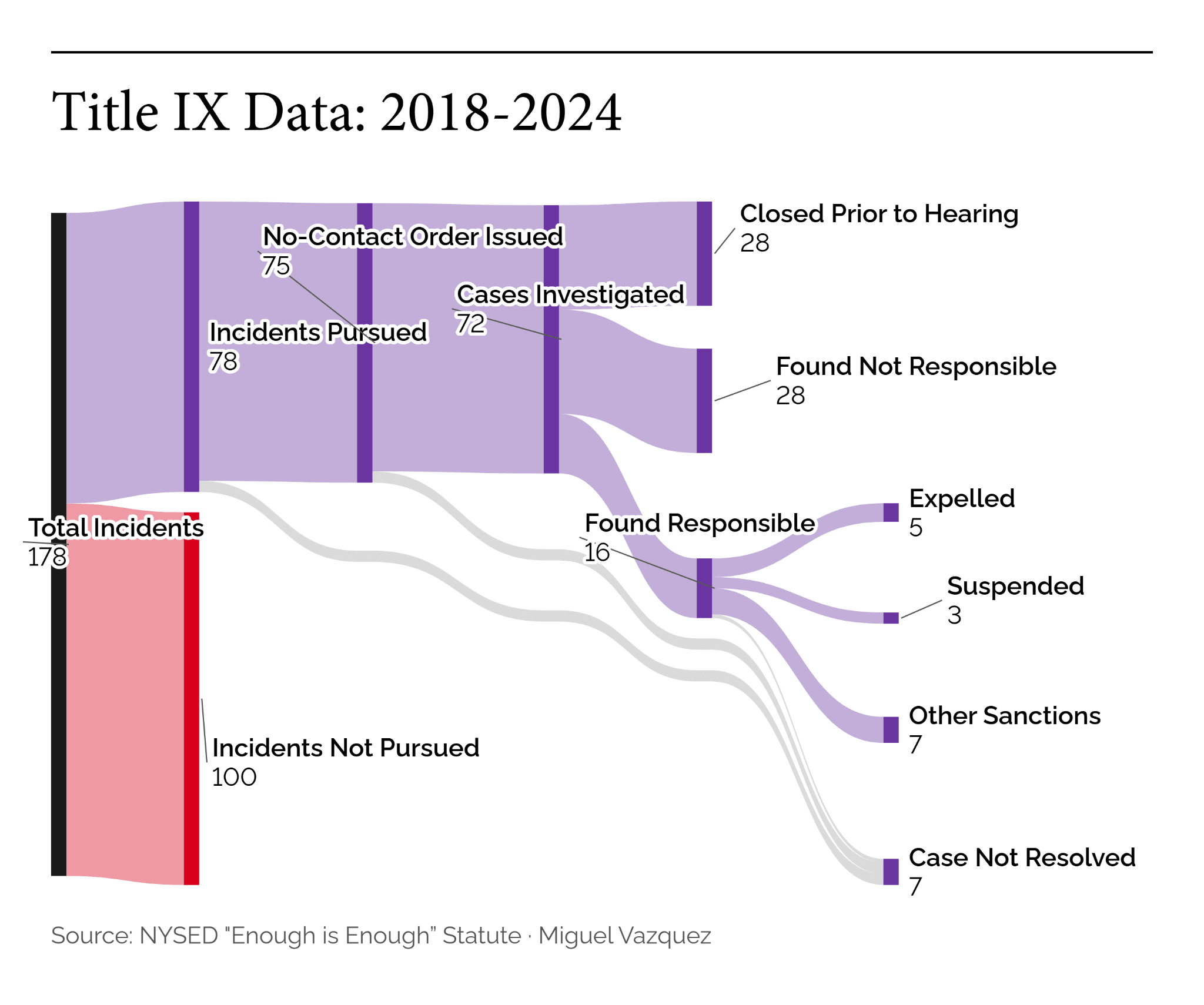
The Title IX Office primarily relies on counteractive measures to ensure the safety of RPI students, yet inquiries were made into the proactive measures that the office can take to reduce the number of sexual violence cases. In addition, the Title IX office is currently only run by one RPI employee, after the second Title IX coordinator left, raising questions about the feasibility of processing all of the reports with full competence. Graduate Senator Paul Lea ’26 ’27G questioned Brown-Goyette about the propagation of “Incel Culture” on RPI due to the large ratio of men to women on campus. Brown-Goyette responded by saying that the Title IX office is unable to regulate the student populace of “Incel Culture,” while the Dean of Students, Dr. Ryan Keytack, stating that his office is currently attempting to target misogynistic culture on campus.
While the forum gave insight into some of the processes of the Title IX office, it left many attendees with unanswered questions about the proactive defenses against sexual violence and did little to instill confidence among the members of the Student Senate. In a later meeting, the Student Senate unanimously moved to charge Lea and FSL Senator Misha Fedak with the task of collaboration with the Dean of Students Office and the Vice Provost for Health and Wellbeing to recommend Title IX procedures. The Senate cited the ongoing distrust in the Title IX Office and a need for clarity and reliability as precedent for the motion. Lea and Fedak will present their preliminary efforts to the Senate in their meeting on November 16.
This Senate meeting was held on October 19. Senate meetings are held every Monday at 7 pm in Shelnutt Gallery.