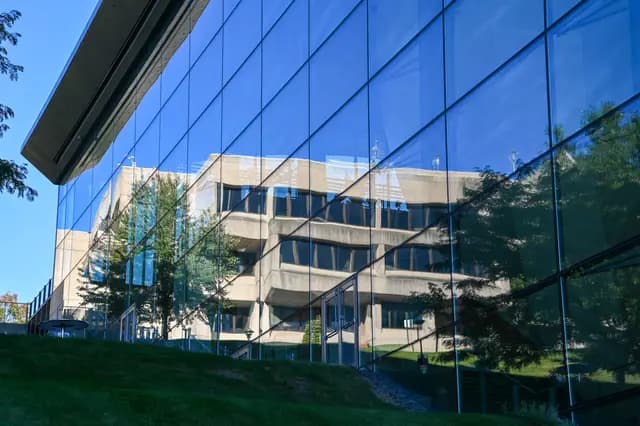


RPI’s Gaerttner Linear Accelerator facility, located at the eastern end of campus on Tibbits Ave, is being taken offline from mid-2027 to 2028 to continue a multi-million dollar upgrade project backed by the Department of Energy. The Gaerttner LINAC, originally sponsored by the Atomic Energy Commission, is now being backed by the Naval Nuclear Laboratory, Naval Reactors, and the Nuclear Criticality Safety Program through a direct $7.4 million grant as well as a joint funding effort between all agencies and the Institute to completely renovate the facility, which is the only one of its kind in the United States.
The Gaerttner LINAC emits a beam of electrons from an electron gun that are then accelerated along a path by a series of radio waves in the low gigahertz range to energies of up to 100 million electron volts. At the end of the accelerator is a block of tantalum, which absorbs the energy of the electron beam and in turn releases high energy photons and neutrons. A linac can fire off this beam for just a few nanoseconds at a time, creating pulses of radiation that can then be used either for data aggregation or use as a particle beam for induced nuclear reactions The same technology is used in hospitals worldwide to administer radiotherapy to cancer patients, a process that capitalizes on the penetrating power of x-rays and protons to destroy cancer cells noninvasively.
The Gaerttner LINAC was originally built with the intention of measuring the probability and methods of nuclear interactions within reactor cores—specifically, the interactions between neutrons produced during nuclear fission and the materials that make up the reactor. The rate of these interactions, measured as the neutron interaction cross-section, is too complex to be simulated and thus can only be determined experimentally for individual materials at specific energies. To take these measurements, the Gaerttner LINAC creates hundreds of neutron pulses per second, each targeting specific neutron energies, and records interactions with a series of detectors. Data collection at the Gaerttner LINAC is strongest for the thermal region and the resonance region, which means it can record the highly variable cross sections as certain incident energies produce much higher rates of interaction in energy regions known as “resonances.” These measurements at RPI are chiefly overseen by Dr. Yaron Danon, director of the Gaerttner LINAC and RPI’s nuclear engineering program, as well as Chairman of the Measurements Committee for the US Cross Section Evaluation Working Group and member of NCSP. The Gaerttner LINAC is the only facility in the country, and one of two in the world, that can measure the resonance region with enough accuracy and range to be useful to the nuclear engineering community.
Assistant Professor of Nuclear Engineering Dr. Dominik Fritz is one of several researchers who utilize the Gaerttner LINAC. His main focus is not on the Gaerttner LINAC’s typical functions, but rather on the production of radioactive isotopes and their precursors that are utilized in various nuclear medicine techniques, such as technetium-99m. Due to the short half life of this particular technetium isotope, around six hours, instead of directly producing technetium-99m, molybdenum-99 is created instead, which then decays into the usable technetium-99m minimizing the loss of material due to radioactive decay. These isotopes are produced by bombarding large nuclei, such as tungsten, lead, and tantalum with neutrons, releasing high energy x-rays and scattered neutrons. These scattered neutrons then continue on to interact with additional targets, producing the desired isotope. Furthermore, Dr. Fritz works on the collection of important nuclear data on how radiation, especially neutrons, interacts with materials, which furthers the scientific community’s understanding of nuclear fission and the operation of nuclear reactors. Along with his research work, Dr. Fritz teaches two courses at Rensselaer Polytechnic Institute, Nuclear Instrumentation and Measurement, focusing on the detection of radiation, and Radiological Engineering, which emphasizes radiation safety and how radiation impacts health.
The LINAC refurbishment has been proceeding in phases to limit the downtime of the device. As the accelerator is an important tool used for research and for senior classes in the Nuclear Engineering program at RPI, keeping downtime minimal is highly important. Currently, the refurbishment has two major phases remaining, dubbed phase 3 and phase 4 respectively: power supply replacement and section replacement, with upgrades.
In phase 3, the remaining radio frequency power supplies will be replaced for maintenance. In order to perform these replacements, the accelerator will be shut down around June 2027 for an eighteen-month period. During this time, seniors and graduate students in the Nuclear Engineering department will be able to conduct their work using hybridized data from our other facilities and devices, alongside historical data from the LINAC. Specifically, deuterium-tritium fusion sources among other high activity radiation sources will be utilized for shielding, dosimetry, and other experiments.
Phase 4 will take place some time after phase 3, however the timeline is yet to be determined. During phase 4, sections of the LINAC will be replaced to increase its power from 10 kilowatts to 45 kilowatts and its energy from 60 MeV to 140 to 150 MeV. In the kilo electron-volt range measurements, a very important region of measurement for nuclear reactor applications, the power will be increased by a factor of ten. By having greater flexibility in the range of energies the accelerator can achieve, a greater range of isotopes can be produced, allowing more research possibilities. RPI’s nuclear department has also been tasked with finding workarounds in undergraduate and graduate education. The Linear Accelerator Laboratory, taken by nuclear engineering juniors and seniors in the spring, may be replaced with an experiment procedure utilizing the two deuterium-tritium generators that will be available at the Gaerttner LINAC facility. Even after the Gaerttner LINAC is operational again, there are plans to incorporate some of the alternate experiments into the curriculum, allowing students to be exposed to more experiment types and devices, and freeing up more LINAC run time for other uses.
It is important to note that, with the existence of external funding and research partners, it is unclear what impact, if any, changes to the Campus Master Plan would have on the Gaerttner LINAC renovation schedule. Funding for the plan is set to come from outside donor contributions, and therefore is highly susceptible to variations that could delay certain plans for construction. It is unclear where the renovation of the Gaerttner LINAC building falls in terms of priority for RPI itself. However, the existence of external support for the project puts it in a more secure position than several others on campus. With good fortune the renovations will continue as planned, and the Gaerttner LINAC will once again be the hub of nuclear engineering at RPI and a critical resource to researchers around the globe.