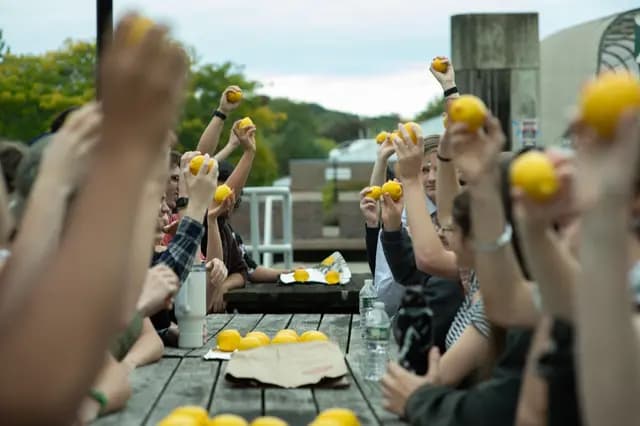
Among all the “Face The Waste” cubes last week, the most interesting and unique of them was arguably the food waste. When someone drops the triple-R mantra (reduce, reuse, recycle) most people picture aluminum cans and cell phones, not leftover pizza crusts. Yet it has been estimated that up to 600 pounds of food waste is thrown in the garbage each day. The Engineers for a Sustainable World food waste utilization project intends to do something about it.
There was a push 10 years ago to implement composting on campus. It failed within a year. Fortunately, sustainability efforts are being renewed, as witnessed by the recent success of the campus-wide Sustainability Charrette last weekend. ESW, in coordination with Sodexo, has revived this effort. The intention of the project is to eliminate the need to have our food waste transported to a landfill, thus freeing space in them. Instead, it would be transformed to create beneficial products and byproducts. Two of the most efficient means of utilizing food waste are composting and biodigestion, and both are being considered by EWS as options for closing the food loop on campus.
Composting (aerobic digestion): Composters have provided a way to use organic food waste to produce a nutrient-rich humus soil for growing plants. Since the mechanism is aerobic digestion by bacteria, the composter must be open to air flow, and it is a more time-consuming process than anaerobic digestion, lasting anywhere from several days to several months, depending on the feedstock and conditions.
Biodigestion (anaerobic digestion): Biodigesters can break down all organic waste to form products that can be used as energy. This mechanism is anaerobic, which typically causes the inside of the biodigester to become murky, putrid, and moist. Depending on the vessel type, conditions, and feedstock, the cycle of a biodigester can typically last anywhere from five to 60 days.
ESW is interested in developing the second option and meets every Thursday at 8:30 pm in the Environmental Education Center lounge to discuss further steps for developing this technology on campus. Jump on board, and bring your own ideas as well!
Comparing:
• Produce usable and beneficial products
• Beneficial to campus outlook on sustainability
• Many different types of organic waste can be used
Contrasting:
• Products: Composting yields a humus-like soil, carbon dioxide, heat, and water, while biodigesting yields methane, carbon dioxide, and sludge
• Conditions: Composting is aerobic, biodigestion is anaerobic; temperature can range a little higher for composting but lie around the same temperature; oxygen content is more difficult to get right in composting than in biodigesters
• Energy from methane produced from biodigesters
• Composting is a relatively easy process to set up
• Biodigesters smell terrible
• Composting creates directly usable soil for the greenhouses
• Biodigesters capture methane from escaping to atmosphere, unlike composters, and produce energy
Other Issues:
• Cost of project
• Feasibility of task effort involved in process, number of people working towards project, management of task
• Ongoing servicing and work involved after startup stage, plausibility of this happening