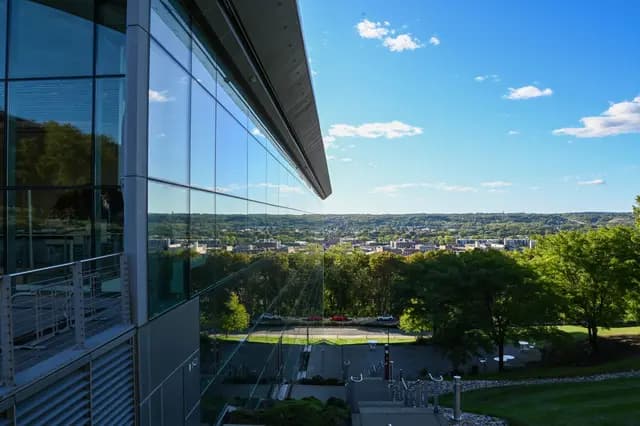
For those who dare to complain about not having anything to do around campus, all of your complaints should have been shushed with the grand opening of the Experimental Media and Performing Arts Center, which drew in over 2000 people, including some from outside the United States and many more traveling from New York City. This was evident when I heard numerous languages surround me as I took my seat in the Concert Hall to see the DANCE MOViES Commission Premiere. The international panel showed excitement on their faces as everyone waited for the lights to dim to see a glimpse of how “dance meets with the technologies of the moving image.” There were four videos that premiered this past weekend, including Kino-Eye (U.S.A.); Veterans (U.S.A./U.K.); PH Propriedad Horizontal (Argentina); and Nora (U.S.A./Zimbabwe/Mozambique/U.K.). Each film was very different from the others in its distinctive art form.
Kino-Eye began as a small image in the upper left corner of the large screen. The purpose of this beginning became clear later in the film, as most of the film is immersed in the manipulations of the video surveillance of an unaware dancer. Hence, the stolen image is taken from an eerie perspective, constantly in motion and zipping in and out of perspectives so that the screen often carries multiple camera angles. However, this makes the direction of the film hard to capture, and I was left with a lost sensation at the end, grappling to understand what the director’s purpose could be. It may be the case that the limits of time and space so carelessly frazzled in the film are a reflection of the true chaos of events in life, garbled and incomprehensible. Regardless, the short film is inquisitive, with interesting static moments in the absence of music.
The director’s cut in the Veterans was, however, easy to understand. This film clearly depicts the trauma of Post-Traumatic Stress Disorder patients recovering from service in the war. In EMPAC’s description, “the film tracks five U.S. veterans recovering from PTSD as they make their way through the streets of Los Angeles. Locked in solitary battles of isolation, dislocation, and memory, these vets converge in a quiet alley and find themselves joining in a ritual re-enactment of combat before returning to their separate lives.” The comical sincerity of the veterans is a real depiction of the degree of unrest that comes from inability to return to normal lives after war. Directors Margaret Williams and Victoria Marks, known for their moving and visually compelling dance film collaborations, were re-united through EMPAC for the first time in 11 years to work on this film. Marks and Williams worked with veterans to translate their imaginary and real experiences into a visual and kinetic story of longing and displacement. The psychology of each PTSD patient is disturbing: one paints “Try not to get yourself killed 0331” repeatedly on his skin; another drops black clothes in various places (metaphoric for casting aside the death that clings to war), yet the clothes spring back at him stubbornly; another plays ruthlessly with toy soldiers, killing each one off, even lighting one on fire until the wax melts off. Each seems progressively more lost in desperation until he receives a folded paper allowing for the re-enactment to ensue and patch their lives back together so they can cast aside the pain of war. The performers met Marks and Williams while involved in a Combat Rehab/PTSD program at the Veterans Affairs Outpatient Clinic Hospital in West Los Angeles, and the realism that this exercise brought is apparent.
PH Propriedad Horizontal is my favorite from the bunch. It is extremely original, as it uses a cultural aspect in the lives of Argentineans (closed, small alleys) to create an art form. The group uses the limitations and boundaries presented by the confined space to their advantage, as they bend their bodies against one another. In my opinion, the piece is powerful because it is nonsexual and pure, even though the art forms require the dancers to literally rub their bodies together to propel and balance among the walls. The narrow passageway is typical for Argentinean urban housing and is used elegantly yet abstractly in a continual dialogue.
Nora was the last of the short films, based on the true story of the dancer Nora Chipaumire. The film fully expands the struggles in the dancer’s life, from the family drama and difficult love affairs to the militant politics. The tone of the film shifts from mournful to joyful, from tragic to uplifting. The strength of the dancer embodies the pride and the independence essential to survive in the world. The power of Africa was also very vividly depicted, in its red sand and earthy trees.
All in all, the films are unique in their perspectives of the world. I urge you to go to the additional screening on Sunday, October 12, at 5 pm in the EMPAC theater to see for yourself.