Those coming into the DCC last Friday and Saturday night would have been utterly surprised when they bought a ticket and sat themselves in room 308 expecting to watch Batman. Note, guys, that the UPAC Cinema posters actually had the words “Coming Soon” under Batman. What actually happened this weekend in the DCC? The first ever film festival at RPI!
Together with UPAC Cinema, iEAR put together two different films to be played on each night. For those who wandered in thinking of Batman on Friday night, don’t worry, the two films were pretty good.
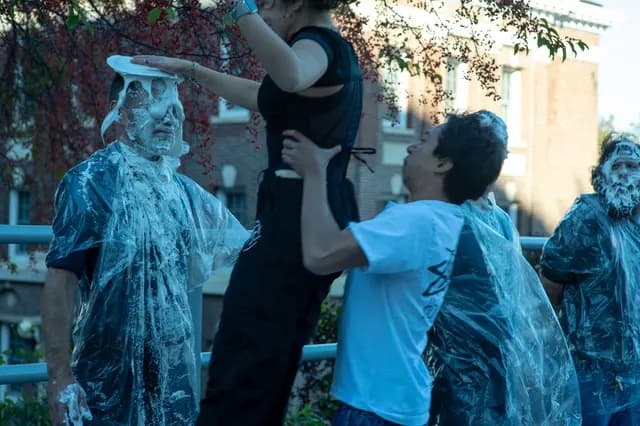
The first movie shown was titled The Yes Men, which featured the dealings of a number of impersonators out to unveil the inner evils of the corporate world. In the movie, the audience follows Mike Bonanno and Andy Bichlbaum as they attend meetings to “represent” the World Trade Organization.
What amused me was the fact that in all these meetings, people continue to be fooled or taken with what speaker Hank Hardy Unruh—a persona Andy created—professed. There was even a point where Mike rips off Mr. Unruh’s business suit to reveal the WTO speaker in a gold-colored suit with an inflatable genital. The crowd clapped and chuckled as Mr. Unruh continues to spout out ridiculous nonsense about his outfit being connected to “pleasure” and “business.”
It was also completely surreal how a number of people were still unable to recognize that Granwyth Hulatberi, Kinnithrung Sprat, and Andreas Bichlbauer were all the same person (namely, Andy). The whole scenario reminded me of a cartoon superhero, where one meager mask is capable of holding the superhero’s identity secret from his supposedly clever nemesis.
The whole film was well done, and it exuded a ton of humorous aspects to The Yes Men mission. From the gold “work and leisure” phallus suit to the recycled hamburgers—which made me re-think my hamburger diet—the audience couldn’t help but laugh at the comedy of the whole situation. The Yes Men was definitely a film worth watching.
Another movie was played after The Yes Men. entitled Me and You and Everyone We Know. The film narrates a story of a number of characters all trying to connect to each other and to the world they live in. The movie introduced a modern artist working as an elder cab driver, a shoe salesman just separated from his wife, two girls trying out new sexual experiences and using the shoe salesman’s son as a guinea pig, and the son’s brother, who was caught in a world of internet chatting.
No wonder the film won many acclaims, including a number of awards at the Cannes Film Festival in 2005. The director and writer, Miranda July (who also played the modern artist), created lively and interesting characters, all searching for their niche in life.
There was a scene where July’s character tried to save a goldfish from certain death by driving steadily in front of the car that carried the goldfish unattended at the top. Unfortunately, the goldfish’s life was unable to be saved, but we saw the artist start to see the goldfish in a new light. It seems that was her way of connecting to a certain part of life.
The film went on to give the audiences a visual of courting lovers with the use of pink shoes; a humorous anonymous call in which the caller shouts out “macaroni” and hangs up; and a strange internet conversation consisting of the words “back and forth” and “poop.” If you’re not getting any of this strangeness, I recommend watching the movie. Who knows, you might find some meaning to hope, life, and happiness.
Saturday night, the films were much more sober and not at all humorous. So perhaps that might have been when people might have craved Sin City or Batman more than anything else.
We started out watching The Time We Killed, a black and white film by Jennifer Reeves. The movie was about an author who just proclaimed becoming a recluse during the U.S. invasion of Iraq. The author is plagued by many incidents of her past and is also haunted with death around her. She had just heard that two of her neighbors died due to carbon monoxide poisoning, and even her boyfriend was dead, too.
The movie itself had very good effects and camera shots, but other than that, I found it dull and uninteresting (and just a little bit depressing). Perhaps, because I am not a fan of black and white film, I am giving a negative review of the movie. Had I found anything more positive, however, I would have pointed that out instead.
As is, once the movie was over, I had hoped the one after it would not be as monotonous. Thankfully, the last film was in color!
Tarnation was a disturbing documentary of Jonathan Caouette and his life with a schizophrenic mother. It truly was much of an eye-opener to some of the oppressions of the world: drug overdose, physical abuse, the troubles of homosexuality, and rape.
Caouette has filled the film with three generations’ worth of his problematic family. From pictures, oral stories, and the actual videotaping, Caouette weaves a sad tale of what his family was like and how they survived through a lifetime of disturbances.
Overall, the film was a collage of his family history, and Caouette went about putting it together as if he was scrapbooking. Though this film was definitely a step up from The Time We Killed, I much preferred the other two on Friday night. Perhaps I’m much more of a fan of humor than anything else.