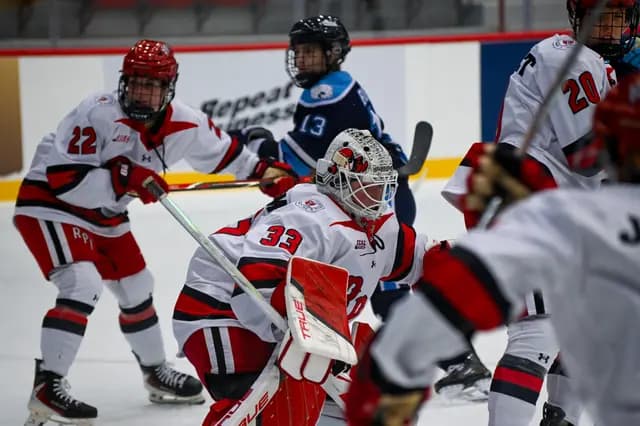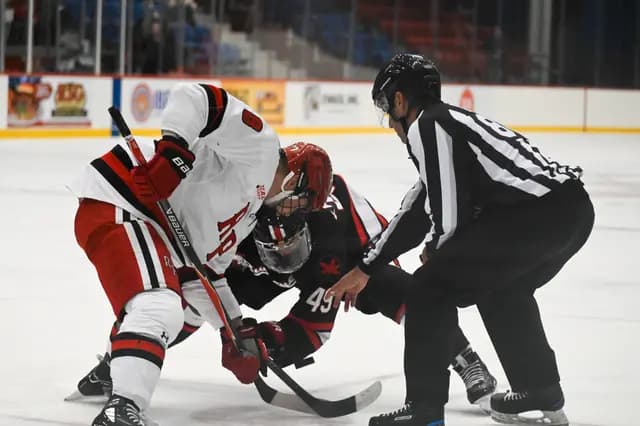
Men’s hockey coach Eric Lang returns for his second season with Rensselaer. His first season, rife with high squad turnover, ended the regular season on a promising 5-2-1 run before bowing out to Clarkson in the conference’s Eastern College Athletic Conference Hockey Tournament. As the team gears up for the 2026-2027 season, The Polytechnic interviewed Lang on his thoughts on his first season, player development, and building a team in the NIL-era.
The following is a transcript of our April 23, 2026 interview with Lang. The transcript has been edited for clarity.
The Poly: How did you feel like your first season at the helm went? What expectations did you aim to achieve, and to what extent do you believe that they were achieved?
Lang: Let me rewind this time last year, when we needed twenty hockey players. There was a lot of stress and pressure to just make sure we were able to put a competitive hockey team on the ice, which I think we were able to do. We wound up winning eight games inside of the ECAC, and we won eleven games overall. I really look at our first year as an incredible success. We were picked second to last place in our league, and we had an outstanding 5-2-1 finish - those are good signs for our hockey program. One thing I think we can say about our hockey team is we were exponentially better at the end of the year than we were at the beginning of the year. We all aspire to play our best hockey late, and our hockey team certainly was doing that. We were a very dangerous team at the end of the year, and really proud of our guys for their stick-to-itiveness, to stay with it even through some adversity. I really enjoyed coaching the team itself, it's a great group of young men that played for each other and really poured the foundation for how RPI hockey is going to play in the future. In my estimation, it was an outstanding first year from where we were to where we finished.
I was at the last home game, the Big Red Freakout. How much of an impact did the atmosphere have on the players?
Just looking back at that night, our fan base, our student body, got the primary assist in that win for our hockey team. They were loud. They were supportive. They gave us energy. It was as good a home environment as I've ever been involved with. And we need more of that. You know, part of what we are trying to do here is build a winning hockey program. And we need everybody. We need our fan support. We need alumni engagement. We need the city of Troy. We need everything to get this thing headed in the right direction. I put it up against any [team]. We had almost 80 alumni back in town, which speaks to the incredible tradition we have here. That number is astronomical, and it's really a big number because we didn't just celebrate a team. 80 individuals thought it was important enough to come back to their alma mater and support RPI hockey. And it speaks to the experience that the university has given to them, and their willingness to give back. That was a great, great weekend for our hockey program.
Being able to report about that game was one of the highlights of the semester. I've been to my fair share games this season and the attendance has usually been hovering around only one to two thousand people. What’s the best way to get [Big Red Freakout’s] level of attendance on a consistent basis to have the team’s back?
It's a multitude of things. Winning helps, people want to go support a winner. I think Dr. Bowers is doing a great job in terms of creating a great in-game environment where the atmosphere is fun and there's outstanding school pride being built inside of our hockey games. I think our involvement in the community, spreading the good word that college hockey here in Troy is going to be very meaningful. The level of play is as close to an NHL game as you're going to be able to watch right now. And you know, so I think there's a handful of things. There's real excitement right now with our hockey program, and we're going to see great crowds moving forward here for RPI, and we really need to tap into our student population.
RPI is one of the greatest schools, not just in New York State, not just on the East Coast, but one of the greatest schools in the entire country. For our student body to have that school pride and be able to come in and watch us beat Harvard or Clarkson, I think it's going to add to their student experience. We all aspire to have a great educational experience and a great social experience, hopefully our hockey program can add to that.
I hope so too! We're gonna pivot over to the Union game at the Mayor's Cup. That was a tough loss, how did it affect the team? Did the loss have an impact on that strong final stretch of games?
For what was at stake, it really hurt us at the moment because we played really well for 57 and a half minutes. We're at a point in our program where we need to celebrate small victories and we need to build on good days. I liked our hockey team that night. Now I didn't like the ending and I don't like the result, but I thought our guys played a really good game in a pressure-packed environment. Although it's not the result we want, we were able to draw from that experience and grow as a team. If you lose and you lose the lesson, you lose twice. We lost, but we gained from that night in terms of making sure we finish games and we play things out so there was good to take from it. The Mayor’s Cup was another great college hockey environment with over six thousand predominantly RPI hockey fans, which is a beautiful thing. It was a great night that we wished the result would be a little different, but we were able to draw from that down the stretch. And I really think it helped us improve our hockey team.
Let's go back to November after our loss against Union on Blackout Day. You mentioned in the post-game that we need better players. Could you expand on that, and do you think the players have grown into the role expected from you?
I just saw a Steve Yzerman comment, who's the general manager of the Detroit Red Wings, which made me chuckle a little bit. He said “we need better players, and our job as coaches, general managers, whatever that occupation is, our job is to bring in the best.” We're very excited with our 2025-26 recruiting class that came in. But this year, my job will be to bring in better players, and that's our job. And our current players have to continue to develop and be the best at getting better. So I will say that our team last year, boy, did we get better, and that was really exciting to see. And all credit goes to our student athletes in their buy-in from what we were asking. It was a lot of change for these guys. It was something new for all of them, and lots of things for them to figure out on the fly — a new system, new way to practice, new way of doing things, new expectations, new standards being set. iIt was a lot thrown at them at once, and our guys did an outstanding job at getting better. And that's their job, and it's my job, and it's my job here to bring in the best players we can, the best people we can, year after year.
Speaking of new players, the team has recruited eight players and added another three from the transfer portal. How many of these newcomers are meant to have an immediate impact on the team?
We're really excited about the crop of players coming in. We were really strategic about what we were looking for. The nice thing is that the staff had an opportunity to see what we have and then to see what we need, instead of just accumulating hockey players like last year. And now we can be a little more selective. We needed a little more stick skill. We needed a little more offensive savvy. We were able to draft what we needed in terms of where our program is, and that will be an ongoing thing every year. We get to look at our team, look back and say, “we need to get better at this.”
We actually went out to the Western Hockey League and did a really nice job to bring in some top talent from one of the best leagues in the world. We will be a very young hockey team next year, we may play seven to ten freshmen at a time, but we think that that's going to get us on a high cycle in years two, three, and four. The draft-and-develop model is really important for our future, and we are really excited about what we have coming in. We are as equally excited about the players we have returning as this will be their second time through the system and the standards. We think that this could be a good marriage here in terms of blending young with returners.
Speaking of recruiting, RPI is one of the smaller schools in DI Hockey, how does that impact recruitment, especially in the NIL-era? What do you think RPI is able to leverage compared to other schools?
This is an ever changing landscape, right? Some schools have opted [into the House Settlement], and we are not in that space right now, but here’s how we present RPI. You can come to RPI and get one of the best educations in the world and aspire to play in the National Hockey League. We're one of ten to twelve schools in the world that can talk about one of the most incredible academic and athletic experiences. So if you're worried about nickels, quarters and dimes on the front end instead of getting an RPI degree, then you're really short sighted and maybe this isn't a great fit for you anyway. Our academics are our competitive advantage right now. We want to develop NHL players, but we also want to develop the next leaders in the business world. We want to make sure that, whether it be the business world or engineering, you’re able to check both boxes here.
There's so many athletes that need a strong kind of business backing. Even if you go and have a great pro career and play ten years of pro hockey, you have the next thirty to forty years to navigate in the game of life. That navigation will be a whole hell of a lot easier with a degree from RPI.
When you were talking about opting in, you’re referring to the House Settlement. The deadline to opt-in was back in May. Was RPI considering opting in? Is there anything that would force the school’s hand and opt into the settlement?
We're in a great position to sit back and watch this play out. There will be decisions and conversations with Dr. Bowers moving forward in what is good for our university, first and foremost, and then what is good for our hockey program. Let's sit back and watch this thing play out a little bit, and then we can navigate that space, if needed.
Rensselaer are leading ECAC right now with 10 players entering the portal, and we also have four players graduating. How big of an impact do you think this turnover is going to have on the team next season?
We are still in transition here. In this ever changing landscape, the transfer portal is a very viable option for student athletes whether or not the school is a good fit athletically, academically or socially; these players are allowed to go in there and pursue other options. It also allows us to look at two to three hundred new players that may help our program. In a perfect world at RPI, we would love to have been able to recruit and retain our own current players, and then only slightly be in the transfer pool. We don't want to be a school where we have to rely on the transfer portal like last year. And I also think there's something to student athletes that say yes to you the first time around. Those are the players that have picked RPI and have made it an educated decision that they want to be here. In terms of building school pride is how we would like to move our program forward.
Last question, who do you see stepping up and being a leader on the team next year?
We will lead by committee, whether it be Filip Sitar, Kazimier Sobieski, Ethan Bono, [Alfred] Lindberg, or Rainers Rullers. We have a lot of guys that we believe have great leadership capability, and the best teams that I've ever have have team leadership, not necessarily one guy leading that's wearing a C or an A. If we have ten or twelve guys creating high standards and holding your teammates accountable to that standard, we have internal accountability. And when your team has internal accountability, where we expect the most out of each other. We can do special things. We really love the players we have coming back. We have a lot of great leaders in our hockey team.
That’s good to hear and best of luck this Fall!
Thank you so much.