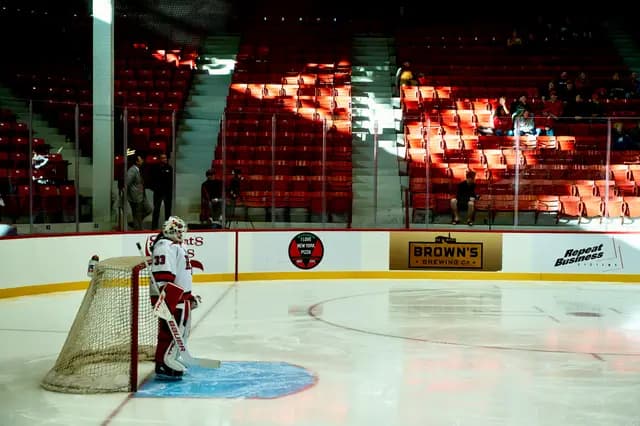
If you were to attend home games during the 1968-69 season with your idea of present day RPI ice hockey, you would search in vain for familiarities. You would be visiting not the Houston Field House, but the RPI Field House where the length of the season was shorter and the ice surface somewhat smaller. Upon entering this grayish edifice you would find no sunken ice surface, no enclosed player benches, no multiple coaching staff, no wrap-around seating at its west end, no banner suggesting the existence of an RPI women’s hockey team, no four-sided scoreboard-clock hanging over center ice, and no advertisements adorning its wooden boards. At first glance, you would have been awestruck.
And yet, RPI’s varsity hockey team in 1968-69 was remarkable. It derived distinction neither from having captured the ECAC regular season championship nor having achieved post season success. By certain evidence, its performance marked a revival of the school’s varsity hockey program from the several dismal seasons it endured earlier in the decade. But we go back to this particular team, speculating and admiring, because the written record has been virtually silent about a delightfully exciting, talented, and inspirational group of pucksters.
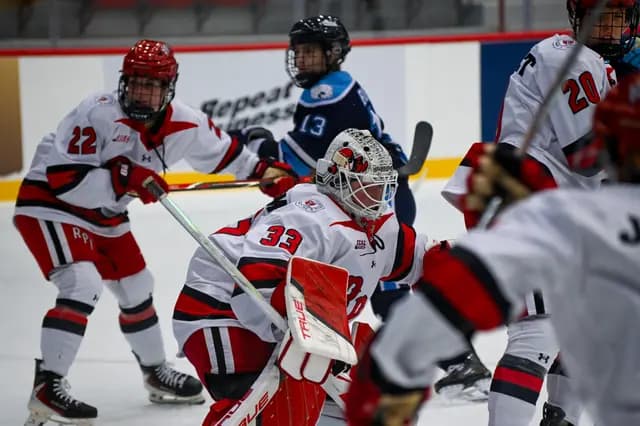
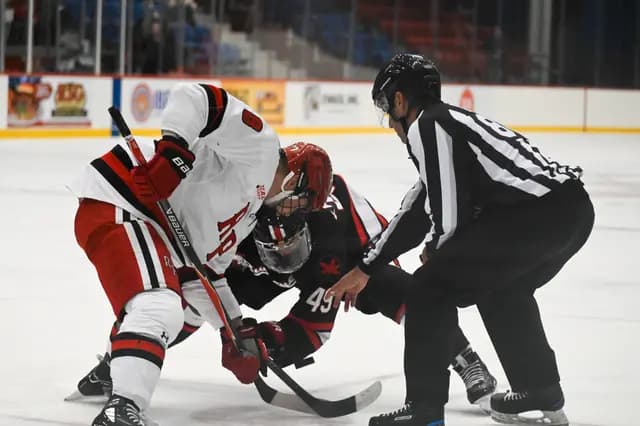
The 1968-69 season was not an easy year. Of course, aggression punctuated a good many performances. Playing in a December home opener against national powerhouse Cornell, talented Dale Watson lost three teeth late in the game as a result of a savage overreaction by a frustrated opponent who brandished his own stick like a lance. Several games later, during the post game handshake with Middlebury College, Tom Nichol, expressing perhaps the commingled stress and bravado from his role as the team’s lone goaltender, decided to punch in the mouth the Panther who had allegedly speared him earlier in the game. A rambunctious second date with St. Lawrence University before a capacity crowd in Troy erupted in the form of a large melee at center ice, from which Paul LaPlante exited with swollen hands and a bloody gash on his wrist requiring six stitches.
Other predicaments emerged, too. A day before meeting Clarkson College and the subsequent match with Northeastern University, numerous RPI players contracted what the newspapers called a “flu reaching epidemic proportions” on the school’s campus, so much so that Coach Garry Kearns, All-American and NCAA scoring champion at RPI in 1956 under Ned Harkness’ tutelage, reported his team’s physical health and ability to compete “was not what you would call good.” Contracting a week-long flu, however, was nowhere near as problematic as failing to pass muster academically. The specter of academic attrition likely haunted senior icemen recalling what their own strong freshman team faced in the winter of 1966. Now in February of 1969, sophomore Barry Sherwood and senior Barry Law faced serious academic trouble, barring their continued participation in ice hockey: Sherwood was the centerman who had served spectacularly as RPI’s goaltender against Boston University when Kearns benched Nichol temporarily for unsportsmanlike behavior. Law, the nifty scorer, together with Watson and Richard Scammell formed one of the most admired forward combinations in the ECAC, perhaps even in the NCAA.
While the mentioned predicaments arise during a routine hockey year, they are enough to devastate any team playing a twenty-one game season. If the 1968-69 pucksters appeared to be mired in more than its share of mishaps and stuttering onward, they challenged again and again what their spectators had been seeing.
Consider RPI’s performances against some of the most highly acclaimed college hockey teams of the day. One was the 4-3 overtime win over Cornell, a celebrated team coached by Harkness, crowned 1967 NCAA champion, led by four All-Americans including sensational Ken Dryden. Another was the 7-0 shutout over BU, whose experienced and skillful core of eight seniors, led by All-American wonder Herb Wakabayashi, helped the school earn second place in the 1967 NCAA final against Cornell. Still another was the 8-6 victory over Boston College, whose seventeen American veterans, including All-American standout and 1972 Olympian Tim Sheehy, had competed in the 1968 NCAA final four. These victories earned impressive praise. Harkness called RPI a “fine team.” BU’s Jack Kelley, calling the RPI-BU game “the toughest game we had in a long time,” asserted that “when they want to play hockey they have a great team.” And BC’s John “Snooks” Kelley, calling RPI pucksters “tremendous,” proclaimed late in the season “they played the best game of any team we have played this season.”
Consider, next, its visit to both Potsdam and Canton, the formidable North Country trip where games have always been intense struggles. The last 57 seasons of RPI hockey history reveal that only three of its teams can claim to have swept back-to-back matches against Clarkson and Saint Lawrence in those northern rinks: the teams playing in 1977-78, in 1984-85, and in 2004-05. It shows too that only three RPI teams earned as much as one win and one tie on this trip: the teams playing in 1952-53, in 1968-69, and in 1985-86. In winter of 1969, the cherry and white edged Clarkson’s team 5-4 in the game’s waning seconds; and the next night, it skated to a 5-5 overtime tie against SLU. But officiating at SLU’s Appleton Arena was said to have been biased; RPI, certainly the more skillful of the two teams, had been penalized heavily and unjustifiably, and, as a result, the Larries managed to score four power play goals. Next day, the RPI Pep Band together with friends of RPI hockey greeted the team when it arrived in Troy to acknowledge so admirable a school sporting feat. Days later, The Rensselaer Polytechnic captured adeptly the reality: “As one St. Lawrence broadcaster said to a WGY broadcaster: You [Rensselaer] were robbed [by the officials].”
In all this, consider RPI’s collective team spirit, resiliency and resolve over the course of the entire season. Of RPI’s twelve overall victories, six of them were come-from-behind efforts. The cherry and white also came from behind to earn its sole tie with SLU. No less interesting is that six different RPI skaters tallied game-winning goals. In victories against Cornell, BU, BC, Clarkson, and SLU, eleven different RPI players scored goals. Although losing to Montreal University while Nichol was benched, the cherry and white demonstrated exceptional character in its support of both Sherwood’s successful goaltending performance against BU and defenseman Brian Dickey’s successful goaltending performance against strong Division 2 opponent Merrimack College. By the end of the regular season, moreover, RPI was the only ECAC team besides Cornell to have earned a record better than .500 against playoff contenders during regular season play. “These guys are very close to one another,” declared Kearns, who contended it had been a long time since an RPI hockey team played with so much spirit. “They went out there and skated very hard.”
The team formed a web of dependencies. But none of this is to say there were no virtuoso performers. Doubtlessly Watson and Scammell were distinctive: Watson because, though he had been enervated by mouth injury, often carried the puck with humiliating ease not only setting up goalsbut scoring them too; and Scammell because he played with a keen sensitivity to the game’s tempos and rhythms and demonstrated a phenomenal wrist shot. Others were special too for different reasons: Nichol for making many wondrously timed saves; Colin Ingham, Gary Mitchell, Kirby Rowe, Jim Blastorah, and Dickey for supplying a gritty, defensive core capable of dependable transitional play; Norm Bean and Law for their offensive prowess; Ross McKersie, Bill Stabler, Doug Hearns, Ron Moreau, LaPlante for their steady, almost palpable wills; and John Renwick, Lynn Taylor, Brian Ronayne, Chuck Rancourt, Doug Chisholm, Wayne Gould, Sherwood, and Dickey, whose complementary skills and emotional support were far greater than any statistical contribution they made.
Like many others focusing on RPI pucksters in the winter of 1969, you may have expected more from a team that had been stopped in a single, first-round playoff match in Bean Town by BU, the very same team RPI had whipped only a few weeks earlier. So it went. And, as it went, so did the blur of events and urgent staccato sounds of RPI’s 1968-69 hockey season. The skates cutting, chopping, shaving the ice; the pucks echoing clickety clack from stick to stick and team to team; Kearns pacing behind the bench, glancing from the score-clock to the action to their bench to his bench, shouting “On him! On him! That’s it! That’s it! There changin’, Who’s up guys? Let’s go!”; the players fingering tape on their sticks, jumping the boards on the go, sometimes squeezing out the breath they couldn’t find, other times giving one another hugs and taps of joy, much of the time shouting “Offside—C’mon, offside! Take’m! Take’m! Move it up! Heads up! Heads up! Right on ya!” and the crowd, expressive and involved, “oooh”-ing and “ah”-ing like a roller coaster riding every game’s rhythm of surprises.
But the 1968-69 varsity ice hockey team casts a spell on posterity and lives in memory by virtue of the qualities beyond those that usually support fame. Its coach devoted himself not only to practicing architecture, but also to fashioning his alma mater’s hockey team so that it could again display mingled flashes of fortitude, sportsmanship, and skill. Its members played the game of ice hockey because they loved to play it and understood—even amid the 1967 NHL expansion which offered fresh dreams to young men skating in the ranks of Division 1—they were RPI students first and athletes afterwards. Going back to the last home game of the season amidst a lively capacity crowd and a pep band playing Herb Alpert’s rendition of “Spanish Flea,” you may have noticed an article in the game program entitled “A Talented Group Leaves.” Its lead paragraph read: “Two years ago a group of very talented sophomores started what would almost have been called a revival of RPI hockey which has culminated this year in a berth in the ECAC Division I playoffs after a long drought. Tonight that group makes its last appearance at the Field House. They will be gone, but not forgotten.”