
Consider a strong permanent magnet in an electric motor. Neodymium iron boron, or NdFeB, magnets offer the greatest energy density of any commercial permanent magnet on the market today. They allow electric motors to produce substantial torque without becoming unnecessarily large or heavy, directly affecting the design and efficiency of electric vehicles. But this creates an unusual engineering problem: what happens when the material that makes a technology good is also difficult to replace?
In policy circles, these magnets are often cited as the reason why the United States must diversify its domestic mining infrastructure. However, evaluating the technological superiority of a country just by the volume of ore extracted does not account for the fundamental chemistry required to refine it.
Contrary to popular conception, “rare” earth elements are not geologically scarce. Most are relatively abundant in the Earth’s crust. However, they are rarely found in concentrated deposits that are economically viable to extract vis à vis how many other mineral commodities are.
Rare earths refers to a group of 17 elements, with 15 in the lanthanide series, and scandium and yttrium from column three of the periodic table. Across the lanthanide row, electrons begin to fill the inner 4f orbital, which does a poor job of shielding the nucleus from outer electrons. Each additional proton across the series pulls the entire electron cloud inward slightly, causing the ionic radii to shrink gradually across the period, a phenomenon known as lanthanide contraction. These small changes produce substantial differences in magnetic and optical properties, but remarkably similar chemical properties. Exploiting those microscopic differences in ionic radii requires liquid-liquid solvent extraction, wherein a raw mineral concentrate is dissolved in acid and repeatedly contacted with an organic solvent in which one element is slightly more soluble than its neighbor. Each contact stage produces only a minuscule fraction of enriched material, so a separation circuit can require hundreds of stages to reach useful purity on an industrial scale before the materials can be converted into metals and alloys that become permanent magnets.
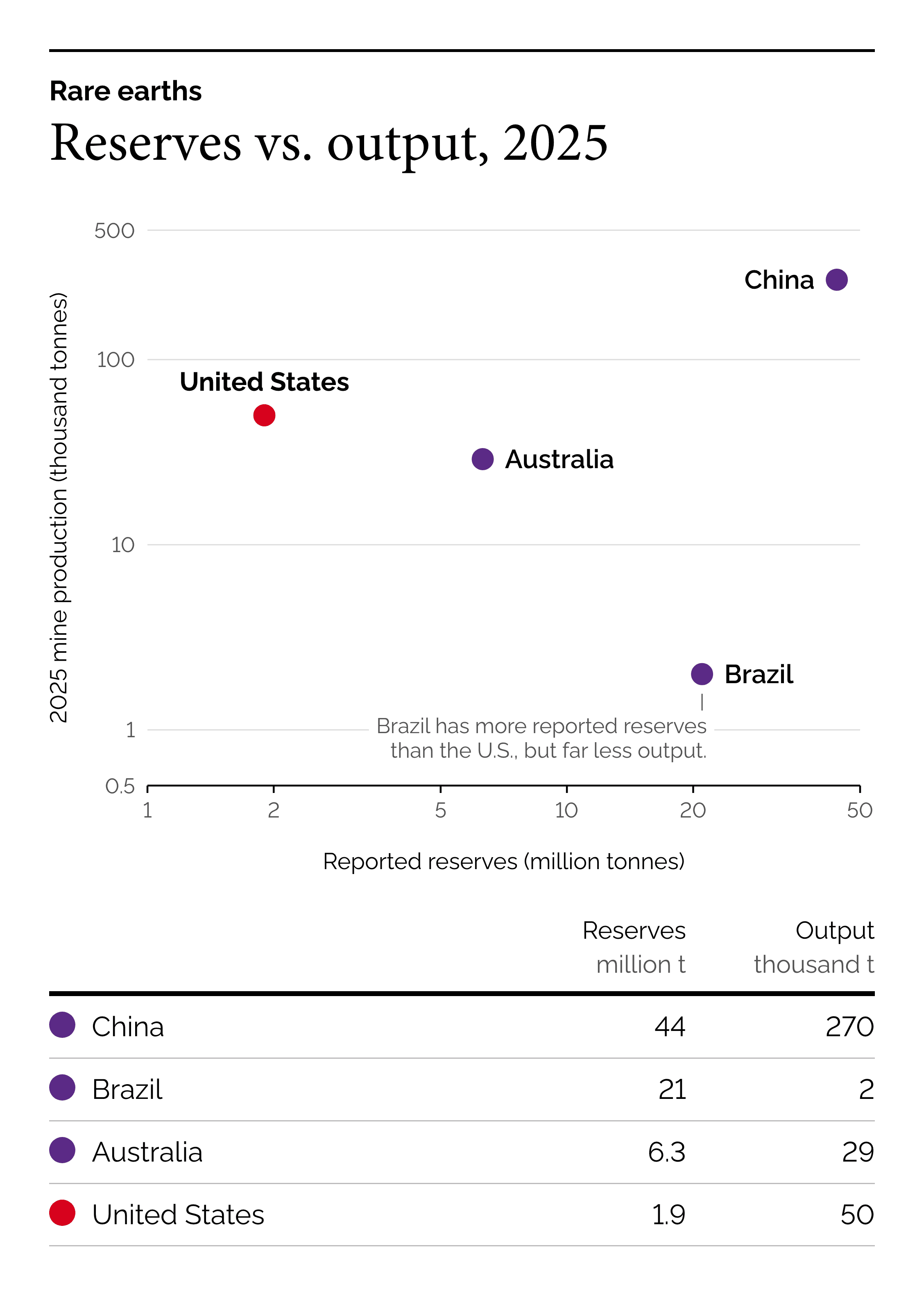
China's position becomes more significant farther down the supply chain. In 2024, China accounted for roughly 60 percent of mined magnetic rare earths, but 91 percent of refined output and 94 percent of permanent magnet production, per the International Energy Agency. According to United States Geological Survey data, China held approximately 44 million metric tons of rare earth natural reserves in 2025, compared with 21 million metric tons in Brazil and 1.9 million in the United States. China also mined 270,000 metric tons of rare earths last year, compared with 2,000 in Brazil and 51,000 in the United States.
Mining the material and having an operating downstream supply chain are two completely different things. That distinction has become more important as the United States tries to build its own rare earth supply chain. U.S. mine production increased by roughly 13.3 percent between 2024 and 2025, and a major proponent of that endeavor is the Mountain Pass Rare Earths Mine in California, operated by MP Materials Corp. They have ventured into alloy and magnet production and announced a $1.25 billion magnet manufacturing campus in Texas. The challenge now lies in reproducing a supply chain that can compete with China's scale and efficiency.
A brief interlude to make a point: semiconductor manufacturing. American companies remain leaders in semiconductor research and development, but much of the manufacturing capacity is based abroad. Subsequent policy changes sought to correct that; the CHIPS and Science Act allocated $39 billion for domestic semiconductor manufacturing and another $11 billion towards research and development, including advanced packaging and manufacturing. The objective is to rebuild industrial capacity that could not be recreated simply by having the knowledge of how to design a chip.
Aboard a similar train of thought, a magnet factory is useless without the refined materials to make magnetic alloys, and a mine is useless without the chemical infrastructure required to process what comes out of it. If engineers can change the technology, they may not need to reproduce every part of the existing supply chain. One approach is to reduce the amount of rare earths used in a magnet. Another is to recover it from existing products and recycle it rather than extracting new material. Each option comes with tradeoffs in efficiency, achievable size, temperature tolerance, cost and manufacturability. NdFeB is dominant because its combination of properties is extraordinarily difficult to reproduce simultaneously.
In December 2023, Beijing banned the export of rare earth magnet making technology and added to existing restrictions on separation technology. It expanded export controls to five additional rare earths in October 2025, including erbium, europium and ytterbium, which are vital to fiber-optic amplification, photonic systems and quantum memories. Those controls were suspended for a year in November 2025, so the risk had been deferred.
The quantities required globally for these optical and quantum applications are relatively tiny compared to the thousands of tons of neodymium consumed by automotive motors. However, criticality is not determined by how much of a material is consumed. A shortage of a bulk commodity like neodymium can raise prices while markets search for substitutes, whereas a shortage of a highly specialized material with only a few substitutes can halt an entire production chain.
The IEA projects that demand for magnet rare earths will rise by about a third by 2030, and by 50 percent outside China by 2035. Announced projects outside China would deliver more than 50,000 tons of mining capacity by 2035, but under 40,000 tons of refining and separation, and only about 18,000 tons of metals, alloys and magnets.
When a technology is developed on a material that is hard to replace, it ends up depending on whoever knows how to make that material usable. For rare earths, the knowledge lies in decades of process experience built to exploit a difference in ionic radius of roughly a hundredth of an angstrom between neighboring elements. That is why mines alone do not buy security. Even if every announced project is completed, capacity outside China would cover under a fifth of its magnet demand in 2035. The cost of closing the gap, about $60 billion over a decade per the IEA, is small next to the $6.5 trillion in annual production exposed to export controls. What money cannot buy is the capability itself.