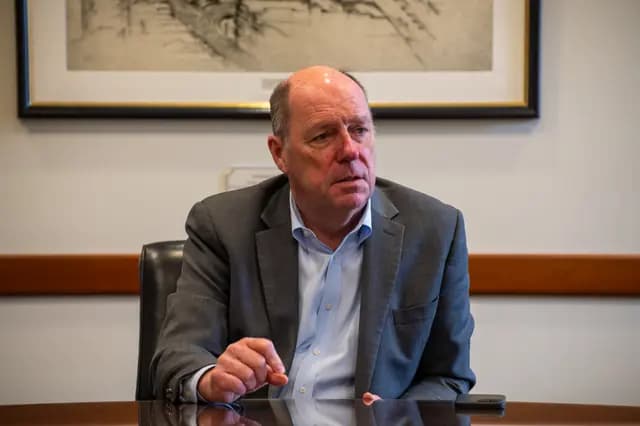
Editor's Note: The Poly sent a questionnaire to every candidate that had filed to run for GM, PU, and UP prior to Spring break. Below are the unedited responses from GM candidate Jordan Krishnayah '28
1.Why do you want to be Grand Marshal?
Everyone here is passionate about whatever they do, and that's what makes RPI special. Go anywhere on campus, and you'll find someone with ambitious plans and goals, whether it's starting a business, wanting to publish their art, wanting to make a difference within their fraternity, or wanting to change the world with their research.
That passion is initially what defined RPI. The drive to create, build, and just do things that we enjoyed is precisely what this school was founded on, as Amos Eaton once dedicated RPI to "the application of science to the common purposes of life."
I feel as if our school no longer has that focus. Previous RPI leadership forced us to look forward, not up– teaching us that RPI is a school where we suffer to get a degree and then go work. Nothing else.
I’m not running for Grand Marshal because I have the answers to everything, nor am I promising to fix everything within one term. I’m running because I want to push this school towards what it could be. I want students to be excited about science & technology or to be excited to go to hockey games or concerts. I want you all to feel like RPI isn’t something you endure for 4 years, but a school that is yours.
And for the first time in a long time, that vision is within reach. Students have regained their ability to govern; the creative energy for arts, music and student organizations is alive as ever. The same passion Eaton hoped to inspire when he cofounded this school is still here. We just need someone to channel it.
I want to lead the charge in bringing RPI together as a school and for the first time in decades, looking up again.
2. What makes you qualified to be Grand Marshal?
I currently serve as the Student Senate Communications & Engagement chair. Under my leadership, we’ve rapidly grown the @rpistugov Instagram account, reaching over 4 million views across 2.5+ million accounts through making short-form ‘brainrot’ content. Initially, the account’s purpose was to advertise student government, but over the course of the past 1.5 years, I’ve shifted priorities to utilizing our social media reach to improve RPI’s brand name across the East Coast by highlighting our student life, and to make Student Government feel more ‘visible’ to the student body at RPI.
Beyond communications, I've been hands-on with other projects in various other areas: I’ve launched the rpi.wiki, a knowledge-base to keep track of RPI related guides & information. I’ve conducted research in AI safety & vulnerabilities, building in-depth
knowledge of the limitations and strengths of LLM-based technologies. I've led dormstorming efforts to collect student concerns directly and ensure that students feel more heard by StuGov. I wrote & promoted the ‘Commons Burger Petition.’ I’ve also drafted the Senate resolution addressing immigration concerns during a time where students felt uneasy about sweeping federal policy changes.
What makes me uniquely qualified is that I combine institutional knowledge of how the Student Senate operates with the technical ability to actually build solutions, and the communications instinct to make sure students see and feel the impact. I understand our bottlenecks inside and out, from where projects stall to where communication breaks down between committees. I’ve placed myself in a position to understand where the gap between the Senate and the student body widens, and I’ve been working within that gap so long that I understand precisely what needs to change.
3. Name three short-term goals (within your term of office) and three long-term goals (beyond your term of office) that you have for the Student Senate.
Within my term of office, I would like to:
- Reform how the Senate and Institute connect with students in-person by establishing Semesterly Town Halls and creating joint committee work/outreach sessions to accelerate our ongoing projects.
- Establish a ‘Rensselaer Media Coalition,’ getting a variety of clubs together and coordinating our social media output as a school. This gives clubs more visibility on campus (local reach) and the school more visibility across the country, which boosts RPI’s name recognition as high schoolers begin to search for colleges with vibrant student life.
- Start off our school spirit goals. I’ll get students involved directly with hockey games from the very start (through a collaboration with FYE & HFH) while pushing for student-made murals either on Freshman Hill brick walls, the DCC tunnels, or the Union.
Some broader goals of mine are:
- Transform our alumni outreach into mutual partnerships. I want to build infrastructure for year-round alumni involvement: mentorship pipelines, career networking, and inviting them on campus for student-run events.
- Modernize the CCPD & URP Programs. By better funding our career preparation programs and doing collaborations with professional development clubs, we can better prepare students for technical interviews, getting referrals, and finding a job in a worsening career landscape. The hope is that our URP program initiatives of creating a centralized system to get involved with research can back up and hone the skills of students across all fields and disciplines, while the CCPD helps them highlight and display this real world knowledge on job applications.
- Unify our technology. QUACS, the RPI Wiki, club platforms, and student-facing technology are all fragmented and poorly maintained. I want to lay the groundwork for a unified digital ecosystem that connects academic tools, club resources, and student information, one that’s built and maintained by students but supported by the Institute. This won't be done in one term, but the architecture, talks, and partnerships with admin need to start now.
4. In your own words, what do you feel are the roles of the Grand Marshal and the Senate? Do you think that the current Senate is fulfilling that role? If any, what changes could be made?
The role of the Student Senate is to focus on legislative and advocacy oriented projects to better the RPI student experience, under the guidance and vision of the Grand Marshal. In an ideal world, a Grand Marshal would set the tone and overall vision for Senate’s projects, which committees work on by developing solutions, contacting administrators, and pushing forth policy changes.
I think the Senate currently is indeed fulfilling that role, but in a structurally unsound way. We have a major issue where many committees are understaffed and overburdened with work, and when committees are stretched thin, there’s lower response time on issues that are critical to the student body.
Because of this friction, there seems to be this common notion that the Senate's too performative, focusing too much on internal governance of themselves and other boards. The Student Senate is arguably the most deliberative organization on campus. I don’t necessarily think it’s because we dislike student-facing projects that just ‘get stuff done,’ but rather the current structure of Senate encourages us to tackle these internal issues first.
I’d want to introduce outreach/work sessions to the Student Senate, where senators and committees collaborate together on various critical projects in one large meeting. Each committee would be able to collaborate with other chairs, and each Senator will walk away from a meeting having felt actively engaged with making direct change on campus.
Another change I would bring is a semesterly Town Hall. These would be highly publicized events in the Union, aiming to have Senators & administrators answer questions from the student body and take input. It creates a sense of accountability by creating a public forum where both Senate and the administration have to show their work, while also providing answers to students on why certain decisions were made.
5. What do you think are the incumbent Grand Marshal’s strengths and weaknesses? What are your strengths and weaknesses that could affect the role? What would you do to improve upon them if you are elected?
T has been an amazing and supportive Grand Marshal throughout my time at RPI, and we’ve often said that if we could describe him in one word, it would be ‘patience.’ He gives everyone a place to contribute in Senate, and has fostered an environment where everyone feels welcome. He has a unique and valuable perspective of the school from his many years at RPI through both undergrad and grad (we call him an ‘unc’ for this though.)
I think one shortfall under T’s leadership has been in situations where he was a little too laid-back. We could have very much issued a response to the Bar contest situation as other students were not happy with the Institute’s handling of the issue. I also think, although I don’t mind getting many emails, the push for the FSL constitutional amendment could have waited, and we lost a lot of good will with the student body by flooding their inbox.
My strengths are in communication and execution, and more specifically, getting really talented, diverse groups of people to work together on projects. Most of the help that I’ve received on my campaign so far has been from non-student government people. (which has proven successful with decent growth on Instagram, local to the RPI community.) I think I have a decent ability to target key players based on their talents, passions, and goals and bring them together to tackle issues while fostering a collaborative environment for them to pitch in.
And as a sophomore, I have a stake in all the projects I push forward as GM. I’m here for another 2 years, and whatever we work on will directly benefit or diminish my experience as I spend time here as a student. A huge portion of my vision for RPI is also inspired by friends & acquaintances that just casually complain to me in a non-student government context.
My main weakness is that I spread myself thin across too many projects. It’s partly what led me to propose outreach sessions in the first place, as I know from experience that one person can’t carry everything. Senate works better when the whole body is able to share the workload of committees, so as GM I’d heavily use the power of delegation to distribute work effectively. I think by focusing on prioritization, delegation, and really selecting the best project leads for committee work, I can accomplish my goals for RPI without directly burning out.
6. What does the student-senator relationship look like? What should it look like?
Right now, for most students, the relationship with their senator is essentially nonexistent. The average student doesn't know who their class senator is, doesn't know what committees they sit on, and has no easy way to bring a concern to Senate without going through channels that feel bureaucratic and unfamiliar. This leads to an issue where students end up venting their frustrations on Reddit, Fizz, or Discord, which often feeds back into this negative sentiment of Student Government.
Students see this negative sentiment, and end up feeling like they can’t get anything resolved through the proper channels even if they tried. As much as I really enjoy making digital content, the real solution is more in-person outreach. More talking to students, and more easily accessible forms of sharing your concerns. It’s daunting to have to go to a Senate meeting, we need to have accessible office hours, public-facing town halls, and ‘dormstorming’ style mass-outreach events to better reach students.
If students complain about something, they shouldn’t get a ‘we’re working on it,’ only to never hear back. We need to tackle the issues head-on, and keep students updated in the process, not with flyers or posters, but by proactively reaching out to them.
7. What does the senator-administration relationship currently look like? What should it look like?
The current senator-administration relationship exists, but is a bit limited. Senate brings issues to administration, administration responds (sometimes slowly), and progress depends heavily on which individual administrator you're dealing with.
The relationship needs to be transformed into a proactive two-way partnership, built on mutual accountability. Administration shouldn’t see Senate "just a source of student input," but as a serious body with the ability to push back, propose alternatives, and hold them to timelines.
One thing I’ve been looking into was a database/tool of some sort that keeps track of Institutional contacts and their relevant expertise/areas of focus. It’s hard for committee chairs to spend weeks hunting down a very specific administrator, and we need a better way to keep track of that. I want to work with the Web Technologies Group to host a contact solution (probably an open source customer relation management system,) and integrate this software with our annual Senate training.
My proposed town hall idea also modifies the senator-administration dynamic. It's much harder to stall on a commitment when you know you'll be asked about it in front of the whole campus.
8. How do you plan to engage with the president of the Institute and the rest of Institute administration?
I plan to approach the Institute president and senior administration as a collaborative but firm partner. The GM is the chief spokesperson for the entire student body, and that position carries weight, but only if you act as a force to push for school-wide changes or resist harmful administrative decisions.
From communication projects we’ve collaborated on, I’ve already built up some small connections with members of the Institute administration, like Provost Doerge and Dean Ryan Keytack. I intend to schedule meetings and get to know faculty from a variety of departments: ranging from facilities, to CCPD leadership, to Houston Field House leadership. Each meeting that I have with administration, I’ll ensure that there’s at least one project that I can bring up as a discussion point.
The establishment of town halls won’t just be for students, but also for administration too. When the Dean of Students or Provost participates in a public forum, they're making themselves accountable in a way that private meetings can't replicate, and directly proving to the student body that Institute Administration genuinely cares about what students think.
I’m not interested in an adversarial relationship with administration, but I am willing to take risks and, if beneficial to students, push back against controversial admin decisions.
9. What qualities should a leader have? How are you a leader?
I believe that a leader should have ambitious visions, be honest, and take proactive risks. They should be able to not just articulate what they want for the school, but explain precisely how they plan to do it and why. A leader also needs the ability to turn their ideas into results, and the discipline to prioritize ruthlessly when everything may feel urgent.
I didn't wait to run for GM to start building things for this campus. I grew the student government Instagram to over 4 million views, because I had a vision of better RPI social media presence that I believed in. I’ve been proactive in collaborating with various organizations, offering my committees support in getting students better engaged with campus resources.
I’ve taken many risks at RPI. I drafted the immigration concerns resolution because it was the right thing to do for student-wellbeing, even if it faced scrutiny for being ‘too political.’ I took a risk (and faced a bit of scrutiny) for the Dormstorming project. And I think that’s okay, because a government that doesn’t take risks is a government that doesn’t get anything done.
I have a vision for the school that I’ve spent the past year and half executing, I’ve taken risks (many of which have paid off,) and I have been committed to making RPI a better place.
I see my bid for Grand Marshal as a continuation of my existing work, as a role where I can hone down what parts of my vision students want, and what I need to fight harder for.