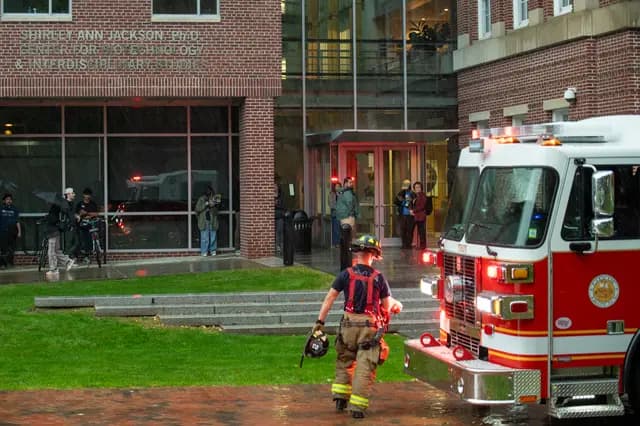
Rensselaer’s second annual Greek Leadership Summit, which hosted chapter leaders, alumni, and members of the Alumni Inter-Greek Council for a day of discussions on greek life at RPI, was held this past Saturday at the Heffner Alumni House.
The morning began with a brief welcome from AIGC Director of Communications Ray Lutzky ’02. After giving a brief overview of the day’s itinerary, he introduced the members of the AIGC present at the summit: Vice President Roger Mike ’72 and directors John Thomas ’02, Ann Dodson ’86, Shannon Kelly ’92, and Jonathan Witter ’82.
Following Lutzky’s salutation, Thomas introduced the morning address speaker, David Haviland ’64. Haviland was a member of the Sigma Alpha Epsilon fraternity during his time as a Rensselaer student and held many different positions at the Institute afterwards, ranging from professor and dean of the School of Architecture to Vice President for Student Life and Vice President for Institute Advancement. Since retiring from RPI in 2005, he has served as the vice president of the Rensselaer Alumni Association.
Haviland began by describing greek life as an enterprise, where students must learn how to lead and appeal to the student body.
He spoke of the varying relationships that greeks have with the Institute, “falling on a spectrum from OK to hostile.” Haviland described the different relationships as going from comfortable, to uneasy, to suspicious, to antagonistic among greek students, and said that, regardless of feelings toward the Institute, students are “obligated to make greek life as good and as strong as possible here.”
He acknowledged that the Institute hasn’t always made it easy for greeks to work with the administration, but encouraged greeks to make the most out of the opportunities presented to them—particularly in light of the looming organizational changes to student life through the Clustered Learning Advocacy and Support for Students model.
“It’s your opportunity to step out and show what you can do,” Haviland concluded, pushing students to rise above whatever challenges are presented.
Following Haviland’s remarks, chapter leaders split up for the next two hours to attend two of the six sessions offered. The sessions ranged from discussions on fraternity living and learning communities to how relations can be improved between the greek community and faculty, administration, non-greeks, and among chapters.
Also offered were discussions on improving communication skills, maximizing alumni networking, risk management, recruitment quality and quantity, and leadership within each chapter.
After a lunch provided by the Office of Alumni Relations and the Dean of Students Office, Vice President for Student Life Eddie Ade Knowles introduced the keynote speaker for the summit, President Shirley Ann Jackson, and stated in regard to the new changes in store for Student Life through the CLASS model that “greek life will be a part of the new step for Rensselaer.”
Jackson began by explaining the significance of the forum, stating that it provided a place for greeks to share ideas and concerns and form a group of “tightly knit but more broadly participatory students.”
She tied in the decisions made at the Institute in regards to the economy with how leaders will have to make difficult calls, but said that “we, as leaders, have to take action.” She noted that, while the actions were painful for everyone, “These steps have positioned Rensselaer to weather this economic storm.”
Jackson continued, “My hope is that forums such as these will keep us all informed and keep the lines of communication open during a difficult time.”
Jackson also discussed the continued interest in Rensselaer for undergraduate admissions and posed two questions to the greek community: “What does a Rensselaer student body of greater diversity mean for your membership and programming?” and “What will the CLASS model bring to you?”
Following Jackson’s keynote, the chapter leaders broke into one of three more sessions (“Leadership in your Chapter,” “Chapter Financial Planning,” or “Trends in Chapter Management”) before coming back to the Great Room for “The Great Debate,” in which students argued the pros and cons of greek life on campus.
-640x427.webp&w=3840&q=75)