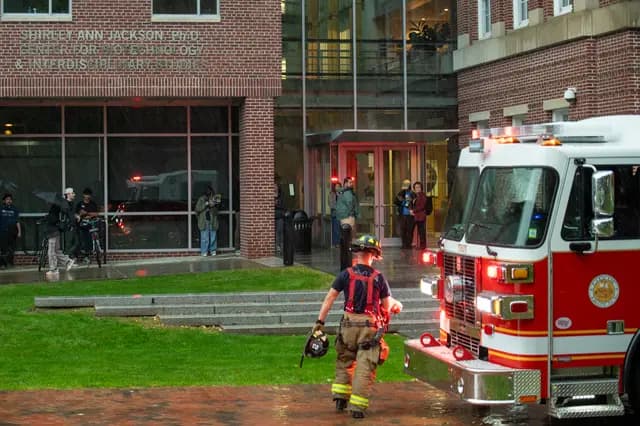
On June 11, Rensselaer hosted a panel of entrepreneurs, visionaries, and academics whose work relates to the World Wide Web. In attendance were Sir Tim Berners-Lee, inventor of the Web and director of the World Wide Web Consortium; Wendy Hall, president-elect of the Association for Computing Machinery and senior vice president of the Royal Academy of Engineering; Nigel Shadbolt, chief technology officer of Garlik; and Nova Spivack, founder of Radar Networks. The panelists discussed the future of the Web and how it will shape the way we interact with our peers, society, and tomorrow’s artificially intelligent agents. Rensselaer Constellation professors James Hendler and Deborah McGuinness moderated the discussion, which was held in the auditorium of the Center for Biotechnology and Interdisciplinary Studies.
The evening started with the introduction of the Institute’s Tetherless World Research Constellation from President Shirley Ann Jackson. In her speech, Jackson reiterated a tenet of the Rensselaer Plan, saying that it was the Institute’s calling to “guide research at the forefront of emerging disciplines.” Jackson said that the Constellation will give “unparalleled opportunities for students and faculty” of cognitive science, computer science, information technology, and mathematics to model the rapidly evolving Web “to make the next generation … natural to use while responsive to a growing variety of policy and social needs.”
Jackson was followed by a keynote address delivered by Berners-Lee, who is credited with inventing the World Wide Web in 1989 while a researcher at the European Organization for Nuclear Research. Berners-Lee explained that the Web’s fundamental innovation is that it allows users to browse content hosted on a network without being aware of the network’s physical layout. He continued on to describe his vision for the successor of the Web, dubbed the Semantic Web, where all content would be annotated with information allowing machines to take advantage of the wealth of untapped data. “The most important thing for your data,” he said, “is for it to be used in unexpected ways.”
Berners-Lee’s explanation of the Semantic Web provided a segue into the day’s panel discussion. In an embrace of Web technology, questions were taken not only from audience members in the auditorium, but also from visitors watching the discussion streamed live from Rensselaer’s website. Questions could be submitted prior to and during the event and voted on in a fashion similar to the website Digg.
The panel addressed questions including the effect of language barriers on information dissemination, how artificial intelligence will cope with the Web, and the possibility of democracies where citizens vote directly from their browsers. On this last topic, Shadbolt was quick to warn that the Web is “like a gun—too early to tell if it will improve freedom.”
-640x427.webp&w=3840&q=75)