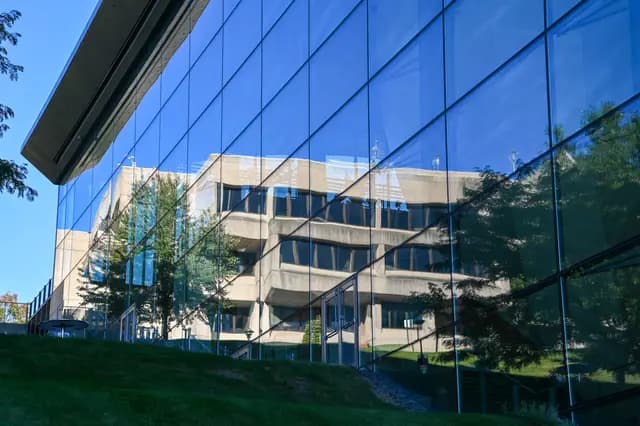
On December 7 and 12, 2006, the Experimental Media and Performing Arts Center opened its doors to a set of students, giving them a firsthand look at the construction and a feel for how the Center will look when it opens its doors in Fall 2008. The $141.7 million project broke ground on September 26, 2003, and has slowly grown out of the hill overlooking downtown Troy.
The tour began outside the main entrance, which, unlike most other buildings, resides on the top floor of EMPAC, facing the MRC and Folsom Library. According to Johannes Goebel, director of EMPAC and the tour’s leader, there will be a drive with a drop-off circle leading right up to the front door allowing patrons easy access to the facility. Much of the facade of the building is made out of a combination of clear and opaque glass, including the front entrance, which is almost entirely transparent.
Energy efficiency is a top priority at EMPAC. The building is wired with temperature sensors throughout, and even the pane glass facade has received a touch of energy conservation innovation. The space between the panes and along the joints is filled with a liquid gel which works to improve the insular qualities of the glass wall, while keeping the glass itself from growing cold. This technology should keep costs of heating the facility down.
The concert hall, on the north side of the building and resembling an ark, has many innovative features. The hall’s ceiling is being touted as its most innovative feature, being made of fabric panels less than one millimeter thick and supported on a web of stainless steel cables. The fabric is designed to be reflective to high-frequency sounds, while allowing lower-frequency sounds to pass through the ceiling. This causes an apparent amplification of high-frequency sounds, supporting the production of the musicians. The space is optimized for a classical symphony, but is flexible enough to be modified to support almost any production.
In addition to the 11,500 square- foot concert hall, EMPAC also features two black box studios, a rehearsal studio, a theater, and a few smaller recording studios. Each of these spaces has been specially designed to ensure they are acoustically isolated from the others. Each of the black-box studios offers a fully customizable space, the larger of which is tall enough that, when standing in the middle of the studio and looking straight ahead, the wall fills the entire field of view and the ceiling cannot be seen, creating a totally immersive environment and allowing someone to actually feel like they are outdoors.
Each of the studios, including the rehearsal studio, will feature Brazilian floors, a feature Goebel touts as unique in research spaces. He said, “Not many spaces think about the experience of the human beings using the space in addition to the research in the space.” Brazilian floors are much easier on the joints of the body, making activities such as dancing and performance much less fatiguing.
The EMPAC theater features 400 seats, a large elevated orchestra pit, and a 40-by-80 foot stage with a 70 foot flytower. The flytower will work on a computerized system rather than the usual manually-operated pulley system common in American theaters. The system will allow for groups of booms to be raised and lowered smoothly and simultaneously. The orchestra pit will also feature a full set of audio, video, and network connections, allowing for the orchestra pit to be utilized as a responsive part of a performance incorporating digital media.
Goebel also mentioned that a space, should the club choose to accept it, would be dedicated to WRPI. While specifically designed with WRPI in mind, Goebel said, “If they don’t want it, we’ll use it for something else, but it’s here if they want it.” The recording studio, while smaller than the one that currently houses WRPI in the DCC, comes with a plethora of features, including direct audio feeds from all of the EMPAC performance spaces, high-speed network access, a dedicated door to access the studio, and acoustic isolation from the rest of the building.