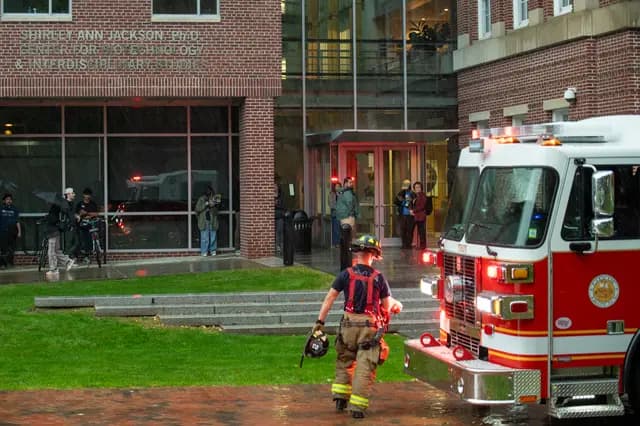
Last Thursday, Dean of Students Mark Smith met with the 28 RPI students being sued by the RIAA and MPAA. These associations recently initiated a series of lawsuits primarily aimed at college students sharing allegedly infringing work on i2hub. Currently, preliminary proceedings are going through the Federal District Court in Albany to obtain subpoenas for the students’ name, school address, permanent address, phone number, e-mail address, and their computer’s physical address.
Also present were Jeffrey Armstrong, Esq., RPI’s attorney for these suits, and John Kolb ’79, RPI’s chief information officer. Armstrong indicated that RPI desired only to proceed in court regarding the subpoenas (as RPI is not being sued), and to that end sought conditions on the release of students’ information. Those conditions included limiting the usage of the accused student’s personal information to the legal matter at hand, more time for RPI to process the subpoenas, and the understanding that names would be identified to the best of RPI’s ability.
Armstrong repeatedly stressed to all students present to get an attorney to intercede in the matter immediately. Once the subpoena is processed, the RIAA and MPAA will move in court to rename the “John Does” in the proceedings to the actual students involved. Once that occurs, students will find themselves involved in legal proceedings that, even after settlement, will remain on public record. Previously, subpoenas by the RIAA and MPAA in other cases, some to North Carolina colleges, were thrown out due to privacy concerns and lack of correct procedure. In this case, however, Armstrong indicated that “the mechanisms they’re using now are being used in a legally correct way.”
The settlement process for RPI students will be much the same as the process for students around the nation. The RIAA and MPAA has streamlined the non-negotiable process into a payment of several thousand dollars, removal of offending files, and a lifetime injunction against sharing copyrighted files online. Several students expressed concern that the whole idea of limiting the RIAA’s use of student information would be defeated by a lifetime injunction, in which the RIAA would probably retain the right to monitor the user in the future.
Some students at the meeting expressed interest in avoiding a lawyer and the associated fees by paying the RIAA and MPAA off directly. Armstrong, however, strongly cautioned against such a tactic, indicating that the presence and advice of a lawyer would be very beneficial, especially when signing a permanent injunction.
It would be possible for students to enter the actual fact-finding stage of court proceedings and challenge the validity of the copyright claims, the selection of defendants, or the nature of the undisclosed methods the RIAA used to access i2hub. Such a venture, however, would be expensive both because of the legal defense fees and the possibility of being made to pay the RIAA’s legal expenses.
When asked about the selection of students to prosecute, Smith said that “there was no pattern or logic to the RIAA’s choice.” As for issues regarding the falsification of evidence, which several students pointed at as easy to accomplish, Smith responded only that the documents the Dean of Students Office had in its possession were extremely detailed, and students could examine them as they wished and possibly mount a defense if they possessed the resources.
While RPI does have every intention of going along with the subpoenas, Smith admitted that “the papers are too extensive…no one has looked at them.” As for dotCIO’s document retention policy, Kolb indicated that “there is no specific time limit for when information is destroyed or kept...If we’re asked to keep information longer, we will,” alluding to the “preservation notices” the RIAA sent to RPI some time ago. One student noted that this lack of procedure left RPI open to requests for records it should not even have in its possession.
The meeting concluded with several students investigating combining their settlements into one transaction with an Albany lawyer, and several others expressed interest in investigating the as-yet-unread paperwork allegedly incriminating them. Although RPI, in a recent press release, stated that “Rensselaer’s Policy on Electronic Citizenship specifically prohibits using, accessing, copying, printing, and storing copyrighted material in violation of a copyright.” Smith indicated that RPI would not be initiating any disciplinary action whatsoever against the students involved.
Last week, President George W. Bush signed the Family Entertainment and Copyright Act of 2005 into law. One of its sections states “any person who willfully infringes a copyright shall be punished…if the infringement was committed…by the distribution of a work being prepared for commercial distribution, by making it available on a computer network accessible to members of the public, if such person knew or should have known that the work was intended for commercial distribution.” The law makes this a federal crime, punishable by up to three years of prison.
-640x427.webp&w=3840&q=75)