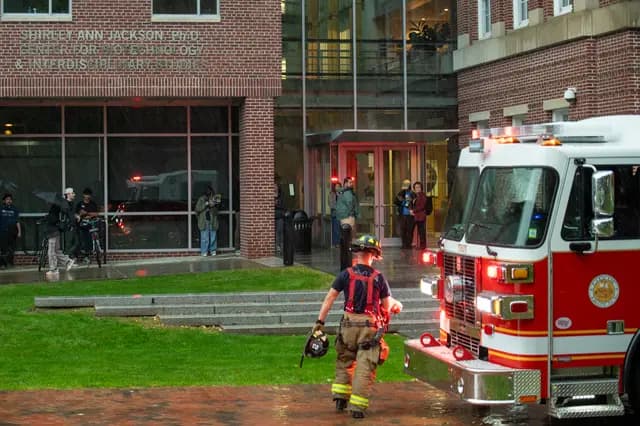
Last Friday’s GM Week finale event culminated with the Rules and Elections Committee announcing the results of the student government elections just prior to a fireworks display. Matt Newman ’05, the chair of RNE, announced most of the preliminary results, and then the two previous Grand Marshals, Mike Borzumate and Mike Dillon, read off the results for the top two student government offices.
In one of the closest races for the top two posts in recent years, Peter Baldwin ’06 was reelected to the position of President of the Union in a 1,123 to 1,011 vote victory over Rachel Evans ’06. The 112 vote margin was just over a five percent victory in the hotly contested race. The victorious Baldwin told the crowd, “I was stunned last time, and I’m stunned this year,” saying that his opponent was also very qualified.
The Grand Marshal race, on the other hand, was a landslide victory. Max Yates ’06 defeated Robert Otlowski ’06 for the position of GM by a margin of 1463 to 638. Yates thanked everyone and said from the stage, “results is what I campaigned on; results is what you’ll get.”
Newman explained that winners for all Class of 2008 offices as well as Independent Council and Class Representatives for all years would be announced at a later time, since those results were not yet finalized. The results were announced over the weekend and the winners of the major positions can be seen in the accompanying informational graphic.
In a later interview, Newman said “Turnout seemed [to be] around where it was last year.” He explained that although the percentages were higher, the number of people who turned out to vote was relatively similar; the difference is that there are fewer people currently at the Institute. All told, 2,177 of 5,922, or 36.58 percent, of eligible voters cast ballots. Last year, by comparison, 2,265 people cast ballots out of 6,752 eligible voters, or 33.55 percent.
Turnout was highest for the freshman class, which had several hotly contested elections. Freshmen cast 767 ballots and hand recounts were performed for many of the races due to very tight races. The closest race was for 2008 Vice President in which Patricia Keenan defeated Sarah Fram by one vote. RNE performed six hand recounts for the race before the result was finalized.
One issue with the freshman ballot led RNE to leave the poll site in the Commons open until midnight. The name of one candidate for class representative was accidentally left off of the ballot, and the error was not caught in the initial draft of the ballot which was posted in the Student Government Suite for candidates to double check.
Newman said that the error was corrected by 12:30 pm. All freshmen received an e-mail informing them of the situation and urged those who voted prior to 12:30 pm on the ballots that lacked a name to revote. Those students who voted prior to 12:30 pm and did not cast a second ballot had their votes tallied for all posts but class representative. This only affected around 130 people. For those students who cast a second ballot due to the error, their second ballot was the one that was counted. In the end, the candidate whose name was initially left off the ballot ended up winning a class representative position.
Unlike last year, the ballot did not include a professorial candidate to be selected to sit on the Promotion and Tenure Committee. Newman explained that this was an oversight and said that the Student Senate was going to select the individual. At last Friday’s Student Senate meeting, Professor Curt Breneman, of the Chemistry and Chemical Biology department, was appointed to the committee in the student selected seat.
Some of the positions on the upperclassman ballots had fewer names than spots available, which led to many candidates winning positions by being written-in. Many people listed on the RNE web site as candidates did not turn in the necessary number of nomination signatures. Newman said, “I don’t know why some of the students didn’t ask for extensions.”
Despite the close races that caused many races to be recounted by hand, the optical scanning software used to tally results electronically did not fail to work as it did last year. Newman pointed out that the software used this year was the software that was used two years ago, rather than the software that failed to work last year.
The close margin was not the only reason why the PU race was so contested. For a time last week, it was not certain as to whether or not Baldwin’s name would appear on the ballot. As The Polytechnic reported last week, Evans appealed an RNE decision to the Judicial Board. The decision in question allowed Baldwin to trade performing additional service hours for the additional nomination signatures that RNE had levied against him in some of their violations “solely for the purpose of fostering a competitive election.”
Last Wednesday, the Judicial Board heard the case, and a decision was handed down later in the day. In a public statement issued later in the week, a unanimous Judicial Board stated, “Decision 14 was deemed to be outside the scope of RNE authority and was rescinded by the Board.” The ruling stated “RNE operates to ensure fair elections” and “Fair elections do not equate to a ‘competitive election.’”
In addition to rescinding RNE Decision 14, the J-Board stated, “RNE was required to convene to re-hear Peter Baldwin’s appeal of Violation 7, as if hearing it for the first time.” Following this required re-hearing of Baldwin’s appeal to RNE, the committee issued a new set of sanctions, including an additional penalty of 50 nomination signatures. This brought Baldwin to a total of 650 nomination signatures needed; he had already turned in 658 validated signatures, and hence he met the requirements to have his name on the PU ballot.