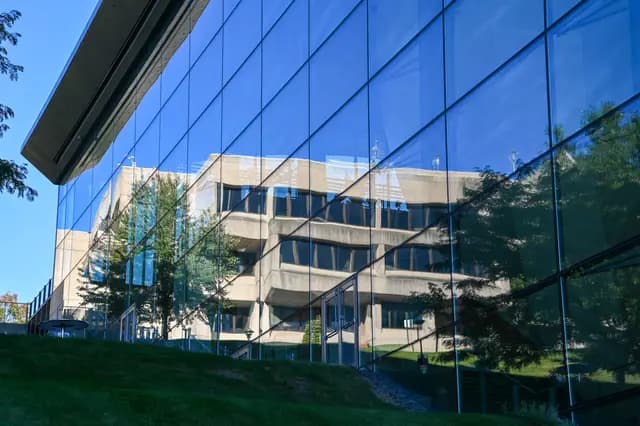
Six influential minds in the area of biology accompanied President Shirley Ann Jackson on the Friday morning opening of the Center for Biotechnology and Interdisciplinary Studies to discuss questions concerning events that will be taking place in the newly opened building. The audience for the colloquy of students, faculty, staff, and guests filled the auditorium in Academy Hall.
Among these esteemed guests were Bruce Alberts, president of the National Academy of Sciences; Claire M. Fraser ’77, president and director of The Institute for Genomic Research and member of the RPI board of trustees; William A. Haseltine, chairman and CEO of Human Genomic Sciences Inc.; James C. Mullen ’80, president and CEO of Biogen Idec Inc. and member of the RPI board of trustees; William Wulf, president of the National Academy of Engineering; and Elias Zerhouni, director of the National Institutes of Health.
The challenges related to biotechnology were discussed at Friday morning’s colloquy. “We may not know as much as we think we know,” Zerhouni admits, as he pointed out the existence of profound gaps in the understanding of the life sciences. Zerhouni commented that compared to other scientific fields such as physics, where physicists can claim that they know about 70 percent of what they need to know, biologist claim to know less than 10 percent of what they need to know.
Coupled with these gaps of understanding, it was Wulf discussed his view on the distinction between science and engineering that has surfaced over the years. “[We really] shoot ourselves in the foot when we draw the distinction between science and engineering,” he commented.
What the new Biotechnology Center hopes to do is bring together both science and engineering so that they can work toward a common goal. As pointed out by Wulf, having engineers working with scientists will add the experience of designing solutions to problems under constraint as well as the experience of satisfying human needs.
The union of both engineers and scientists within the center is not the only improvement to the fields of biology and biotechnology that is planned. As pointed out by Alberts, the need for fresh, new ideas has grown considerably during recent years. One of the systems planned for use with the new center is a system of review groups. These review groups will work to reward new ideas and give young scientists the chance to do something different.
Alberts commented that the age at which scientists get funding has “changed dramatically in a short time.” He pointed out that where scientists were once receiving funding at the age of 27 or 28, they are now receiving their first grants at the older ages of 38. “According to charts, in another ten years, no one will get a grant before they’re 50,” Alberts stated. These older scientists “are not as energetic and adventuresome as before.”
There has been some fear that with the encouragement of interdisciplinary research there will be a weakening of disciplinary research. Alberts commented that there is a need for a new generation of people who deeply understand both biology and engineering, and in order to foster the growth of these people, they need to be prepared at the undergraduate level.
Zerhouni explained that multiple disciplinary research is where scientists from different fields come together and work on a common problem and then return to their fields. He said that interdisciplinary research, on the other hand, aims at creating a “fusion” between different fields of science and technology and having each researcher in the end obtain a more profound understanding of other fields. He also commented on the importance of this fusion if a difference is to be made.
Fraser spoke from her experiences with her institute, saying “we brought people together with very different backgrounds . . . and essentially put them all together in the same space.” According to Fraser, these people, who might not have seen each other in a university setting, were energized by the possibilities in an interdisciplinary atmosphere.
In the closing half hour, Jackson opened up the floor for questions from the audience. Four professors asked questions aimed at advice for the opening center on topics such as a disproportionate amounts of funding going to women and how to take the example set by other similar centers and make it so that the new center at RPI can succeed. Another point of interest was how decisions on what research to fund could be made.
Jackson ended the colloquy with a few closing remarks, stating “The challenges are many, but the rewards are great.”