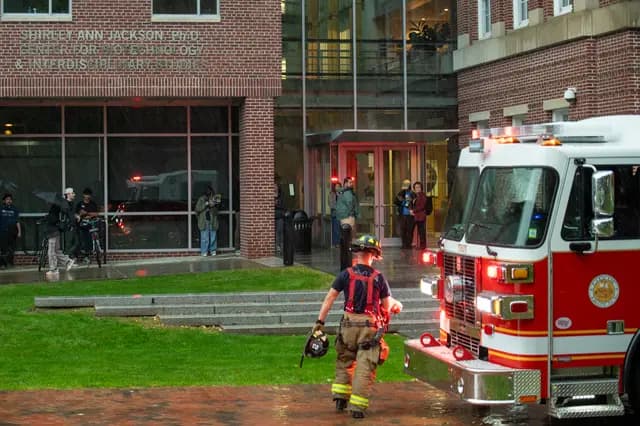
Five months after the Biotech groundbreaking ceremony, the campus construction has exposed tensions between Troy residents and the Institute.
Several of these issues surfaced on August 28 when Rensselaer hosted its fourth monthly public information meeting.
The information meetings are a public venue where residents can openly express any concerns with the current construction projects.
Approximately 20 residents were in attendance and ready to discuss their viewpoint with the members of the administration on hand.
To start off the meeting, Allison Newman, director of community relations, discussed the current status of the project. Fifty percent of the schematic design for EMPAC has been completed. By October the designers hope to submit a concept plan to the Board of Trustees. The Institute is behind schedule according to their original timeline for EMPAC.
The parking garage, on the other hand, is currently on schedule. The excavation phase is underway and the building on College Avenue has already been demolished.
The meeting, in large part, was focused on construction and parking.
RPI plans to issue parking permits to residents who wish to use RPI parking lots but residents who would like to continue to park on College Avenue will not be restricted.
The permit discussion confused and infuriated many of the residents. Claude Rounds, vice-president of administration, was emphatic in stressing that the permits are free of charge and are simply a formality.
The permit is needed, “because we want to know they are residents and should park in those areas.”
According to Rounds the system was designed to ensure that there were parking spaces available for residents. For residents to obtain the permit, they need to present their driver’s license as proof of address to the RPI parking officials.
Another point of concern focused on the Institute’s recent acquisition of neighborhood property.
RPI has obtained a house on the corner of Eaton Road and Sage Avenue. Many of the resident’s believe that the Institute should be forced to pay taxes on the property it owns. RPI’s tax-exempt status drew the attention from Troy residents after the $360 million gift was awarded.
Discussion quickly turned to tackle RPI’s integrity.
Rounds denied any deceit on part of the Institute and stated that the houses that RPI owns will be used to house faculty and graduate students as the research activity and the graduate school growth brings more people to the Institute.
RPI has not yet decided whether to lease or sell the homes to the faculty and students, but currently the properties are not taxable.
“The use of the building determines whether or not it is taxed,” said Redmond Griffin, an attorney representing Rensselaer.
He further went on to explain that if a house were turned into a residence hall it would be tax-exempt, but if it were sold to a faculty member or grad student it would be taxed.
Two residents questioned the 363 acres of Troy’s land currently owned by RPI. RPI is also continually in search of more land. The residents were angered with the fact that the Institute would not attempt to revitalize the run-down areas of South Troy as they have those surrounding the main campus.
“Neighborhoods adjacent to campus are the prime spots for students,” defended Barbara Nelson, project manager.
Nelson explained that RPI’s land purchases and the Institute’s neighborhood revitalization program has partnered with community groups, has applied for neighborhood grants, and continues to establish community outreach projects between the faculty and the surrounding neighborhoods.
According to Nelson, RPI currently has a mobility plan that will serve to lessen traffic, create more parking, and create pedestrian pathways for neighborhoods surrounding campus.
Additional complaints included students taking up residential parking spaces during the hours that they were needed most.
A resident of Sherry Road said that the parking situation has made it virtually impossible for her to entertain guests at her home because it’s impossible to find parking in the proximity of her house.
“We are prepared to work with the city to find alternative spots for students to limit them parking in residential areas,” said Rounds as he discussed the shuttle buses, and current student parking arrangements.
The current plan for Sherry Road is to create sidewalks for pedestrians, specifically students walking to class along the road and the addition of a parking lane. Residents fear, however, “there is not enough room for three lanes on Sherry Road,” said a resident.
“RPI will be building off-street parking lots to accommodate Troy residents who wish to use parking lots instead of College Avenue,” added Rounds.
The Institute is currently building an infrastructure on the south side of campus. There are even plans in motion to repave the poorly conditioned College Avenuue; RPI is “not trying to regulate parking on the streets,” but trying to help the residents out through this adjustment period, said Rounds.
Ron Treers of Clough Harbor and Associates, the architecture firm in charge of the multi-million
dollar project, was also on hand to help facilitate the meeting.
-640x427.webp&w=3840&q=75)