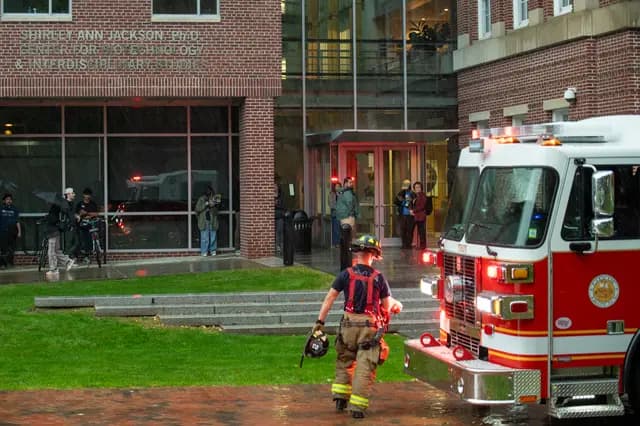
Anticipation filled the air as Institute President Shirley Ann Jackson addressed the state of the Institute in last Thursday’s town meeting. Much of the buzz surrounding the address focused on RPI’s plans for the $360 million anonymous donation. "This donation is a recognition of what Rensselaer is, but more importantly what it can become," said Jackson in her opening.
The $360 million gift is at the discretion of the Institute to use as it sees fit, but the money will be distributed over an undisclosed period. "This [donation] certainly will help us begin. No strings doesn’t mean spending on things that are arbitrary, spending on things that don’t relate to the plan and aren’t strategic," said Jackson.
Audience members asked how, as the Institute enjoys more success than ever, RPI could continue to justify annual tuition hikes. In response, Jackson gave the audience a quick lecture on university economics.
"Universities have only four sources of income—endowment and gifts, investment of the endowment, tuition, and research." Compared to other engineering schools, Rensselaer’s alumni giving rate of 22 percent is very low, Jackson said. In the last year RPI has begun to turn around the situation by increasing the endowment by more than $200 million. "To do what we want to do we need $1 billion more today. Nirvana has not come because we have $360 million," said Jackson.
The gift is also intended to leverage more funds and more donations. In a recent letter to the president, an alumnus increased a previously made donation at the Institute Patron Benefactor level of $10,000. "In the spirit of the anonymous donor I’m tripling my gift," the donor wrote.
In her address, Jackson covered a lot of ground, from the recently approved Institute budget to plans for commencement.
A major focus of the address was issues involving the faculty. The new Institute budget funded two constellations in biotechnology and IT with six faculty members—two senior "star" faculty members, four junior faculty, and additional support for graduate and undergraduate students. Current and planned faculty searches total 34 hires, with 16 planned for next year.
The faculty hirings are planned to fill a variety of positions across RPI. "In the end we do have to grow the faculty. But we’re going to grow it carefully, in strategic areas, where we have the strength to nurture and always with an eye towards leadership," said Jackson.
The president also revealed increases in faculty funding within the budget. The Tuition Cost Sharing Program’s funding will increase to $1.4 million. A new faculty transition fund, administered by Provost Bud Peterson on an internally competitive basis, will be available for faculty that want to return to research. Other new faculty funding opportunities include the interdisciplinary research fund which will target currently funded faculty who want to push their research into a new direction.
Increasing the baseline quality of life at Rensselaer is another priority for the Institute. "We are in the process of developing a long-term, integrated plan to renovate or replace residence halls and major academic buildings," said Jackson. Roofs on the Science Center, Carnegie Bldg., Sage Lab, Playhouse, pool, and Colonie Apts. are slated to be replaced. Another initiative includes upgrading classrooms and increasing the number of studio classrooms on campus. Finally, the Institute intends to make a strong statement to its staff—called the "great enablers" by Jackson—through increasing their numbers and compensating them more appropriately. In the last year, the Institute awarded a four percent across-the-board pay increase for its staff.
The student experience at RPI will also see significant changes. While much of the focus of improving the student experience has centered on the first-year experience, many upperclassmen are concerned about the second-, third-, and fourth-year experiences. In response to a question regarding this issue, Jackson answered, "While our initial focus is on the first-year freshmen, transfer, and graduate students, we have not forgotten about the other class years. But the first-year transition is critical."
As part of a gift from Trustee Mike Herman, RPI plans to integrate entrepreneurship into the curriculum. A comprehensive review of the core curriculum will be made by Vice Provost Gary Gabriele.
"We want to re-identify the vital elements of a Rensselaer education and how biotechnology, IT, and entrepreneurship fit into the picture," Jackson said. She went on to state that there will be an entrepreneurship, biological engineering, or biological science requirement of some kind and that the Institute will be looking to promote IT and the interactivity it brings across schools and give definition to an RPI education in the 21st century.
"The $360 million, in its size, reflects confidence our vision, and The Rensselaer Plan. It is meant to leverage other funds as a starting point," said Jackson.
-640x427.webp&w=3840&q=75)